
English 
Dedicated to global electroacoustic technology.
Views: 0 Author: Site Editor Publish Time: 2026-11-17 Origin: Site


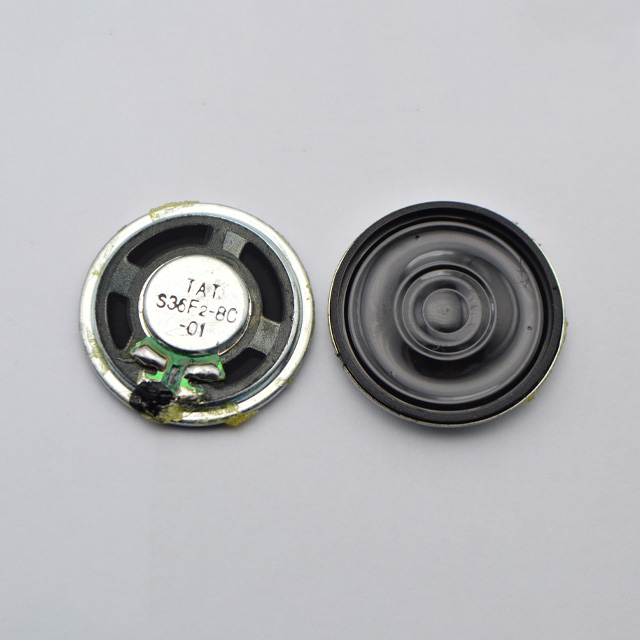
Most audio problems in handheld products are not audio problems at all. They are mechanical ones. The board is done, the firmware is done, and then someone measures the internal height above the battery and finds there is 4 mm where the speaker was supposed to go. That is the constraint the S36 Ultra-Thin Mylar Speaker is built around: a polyester film diaphragm in a 2–4 mm deep package, aimed at voice prompts and alert tones rather than music.
Below is what the part actually specifies, where it fits, and what to check before you commit a housing design to it.
Every acoustic design starts with a volume budget. A moving-coil driver needs air behind the diaphragm to develop output, and it needs clearance in front so the sound can leave. In a handheld device, both dimensions compete with the battery, the display stack and the antenna keep-out zone.
The common failure mode is not a driver that sounds bad on the bench. It is a driver that sounds acceptable on the bench in free air and then loses most of its output once the housing closes around it, because the cavity behind it was never sized for the driver. Thin drivers buy back height, but they do not remove the need to size the rear volume.
A 2–4 mm package changes the shape of that negotiation. Instead of carving a deep pocket out of the stack, you reserve a shallow one and spend the height you saved on something else — a larger battery, a deeper display module, or simply a thinner product.
The published specification table is short, which is useful. These are the numbers on the product page:
| Parameter | Value |
|---|---|
| Diaphragm material | Polyester film (Mylar) |
| Physical profile / thickness | 2–4 mm |
| Frequency response range | 500 Hz – 10 kHz |
| Rated power options | 0.5 W – 2 W |
| Standard impedance | 4 Ω / 8 Ω |
| Expected lifespan | 20,000 – 30,000 hours |
Two things are worth saying plainly about that table.
First, the 500 Hz – 10 kHz band is a speech and alert band, not a music band. There is no low-frequency extension claimed here, and you should not design a product expecting any. What the band does cover is where consonants and warning tones live, which is exactly what a handheld device usually needs to reproduce.
Second, the thickness is given as a range, not a single figure. Tooling decisions should be made against the upper end of that range plus clearance, not against the best case.
The driver needs a sealed or well-defined rear chamber and an unobstructed path in front of the diaphragm. In practice that means treating the speaker pocket as a machined feature with a defined gasket line, not as leftover space between two ribs.
Because the diaphragm is a low-mass film, it starts and stops quickly. That is an advantage for short alert tones, but it also means the part is sensitive to anything that touches the film or blocks the front grille. Keep the front opening area generous relative to the diaphragm, and keep adhesive, foam and cable runs out of the path.
The S36 series is offered with several termination styles — solder pads, custom lead wires, spring contacts and board-to-board connectors — so the electrical interface can follow your assembly process rather than forcing a hand-solder step into an automated line. If your product runs on pick-and-place, the supply format matters as much as the terminal: the series is supplied in blister trays or tape and reel for automated placement.
Whichever termination you choose, strain relief is worth designing in from the start. Lead wires that are pulled taut against a housing wall will eventually fail at the pad, and that failure will look like an audio fault.
The part is available at 4 Ω or 8 Ω, with rated power options from 0.5 W to 2 W. Those two choices interact with the amplifier more than with the acoustic output.
An 8 Ω part draws less current for the same voltage swing, which is usually the safer default on a small battery and a low-voltage rail. A 4 Ω part extracts more power from a given supply, which matters when the alert has to be audible over machine noise, but it also loads the amplifier harder and shortens battery life. Neither choice is universally better; the amplifier datasheet and the thermal budget decide it.
Rated power is a limit, not a target. Driving the part continuously at its top rating in a sealed pocket with no ventilation is a reliability decision, not an acoustic one, and the 20,000–30,000 hour expected lifespan figure assumes the part is operated inside its ratings.
Voice prompts succeed or fail on intelligibility, and intelligibility lives in the mid and upper bands. A driver that covers 500 Hz to 10 kHz with low distortion will render spoken instructions clearly at moderate level, which is what a handheld device usually needs. A driver that reaches lower will produce more impressive bench measurements and consume more space doing it.
If your product also plays music, this is the wrong component family, and no amount of equalisation will add the missing octave. If your product beeps, speaks, or confirms a scan, the band is well matched.
The other practical point is level consistency. A film diaphragm that is properly supported behaves predictably across its band, so a prompt recorded at one level and an alert tone generated at another will not sound like they came from different devices.
The published expected lifespan of 20,000 to 30,000 hours is a long number, and it is worth understanding what it depends on. Polyester film does not absorb moisture the way paper cones do, and it does not dry out and embrittle with age, which is the usual mechanism behind a paper cone going soft or buzzy after a few years in a humid climate.
What does shorten life is mechanical and thermal stress: overdriving the coil, sealing the part in a pocket with no path for heat, and letting the diaphragm sit against a grille or a cable. All three are housing and drive-level decisions, and all three are cheaper to fix on the drawing than in the field.
Measure the finished assembly, not the bare driver. A free-air sweep tells you the component works; it does not tell you what the customer will hear through a grille in a sealed pocket.
For sound level measurements, the reference instrument specification is IEC 61672-1:2013, which defines the sound level meters used to make those readings. For products that generate medical alarm signals, IEC 60601-1-8:2006 covers alarm systems in medical electrical equipment; the standard is the right starting point for the qualitative questions — which signals must be distinguishable, and how they are prioritised — and you should work from the current edition rather than from any summary, including this one.
A practical release checklist looks like this: measure output and distortion in the final housing at the intended drive level, confirm the alert is distinguishable from ambient noise in the worst-case environment, and run an endurance test at the rated power in the real enclosure rather than on an open bench.
Two engineering questions usually decide whether a thin driver is viable in production: whether the parameters can be adjusted, and whether the part can be handled by the line.
On the first, the series supports customisation of physical dimensions, power rating, impedance and frequency response curve, so a design that is close but not exact does not necessarily need a new platform. On the second, the supply format — blister tray or tape and reel — determines whether the part fits an existing SMT or robotic placement process.
For the wider range, the Mylar speaker category collects the thin-film options, and the speaker category covers the full range including multi-media types. If your design needs a slightly larger diaphragm than the S36, the 32 mm ultra-thin Mylar speaker and the 23 mm square-flange Mylar speaker are the nearest neighbours in the same family, and the 18 mm round Mylar speaker covers the smallest end.
That depends on the drive level, the rear volume and the front opening, not on the thickness alone. A thin film diaphragm can produce useful output in the speech band, but the housing determines how much of it reaches the user. Measure in the final enclosure against the actual ambient noise of the application.
It is not intended for it. The specified band is 500 Hz to 10 kHz, which covers speech and alert tones; music needs low-frequency extension this component does not claim. Use a multi-media speaker if music is a requirement.
The impedance changes how much current the amplifier delivers for a given voltage swing. The 8 Ω version is generally easier on a small battery and a low-voltage rail; the 4 Ω version extracts more output from the same supply. The right choice follows from the amplifier and the thermal budget.
The range describes the product family rather than a single orderable dimension, so confirm the exact figure for your configuration in writing before you freeze the housing. Design clearance against the upper end of the range.
With a defined gasket line, a controlled rear volume, and a front path that does not press on the diaphragm. Terminations can be solder pads, lead wires, spring contacts or board-to-board connectors, and the part is available in tray or tape-and-reel format for automated placement.


