
English 
Dedicated to global electroacoustic technology.
Views: 0 Author: Site Editor Publish Time: 2026-11-21 Origin: Site


Two suppliers quote the same 23 mm piezo buzzer. The drawing looks identical, the price differs by a few cents, and the samples both work. Six months later one batch is fine and the other has units that sit at the edge of the frequency band, or arrive with pins that need rework. Nothing in the part number predicted that difference — it lives in the manufacturing process behind it.
So the practical question when you source a piezo buzzer is not "who sells this part" but "who makes it, and what can they show me". This article lists the seven questions that separate a piezo buzzer manufacturer from a trading desk, and what a good answer sounds like. The BPC2310 23 mm active piezo buzzer is used throughout as the worked example: a 12 VDC part rated at 90 dB at 10 cm, 3500 ± 500 Hz, in a black PBT housing.
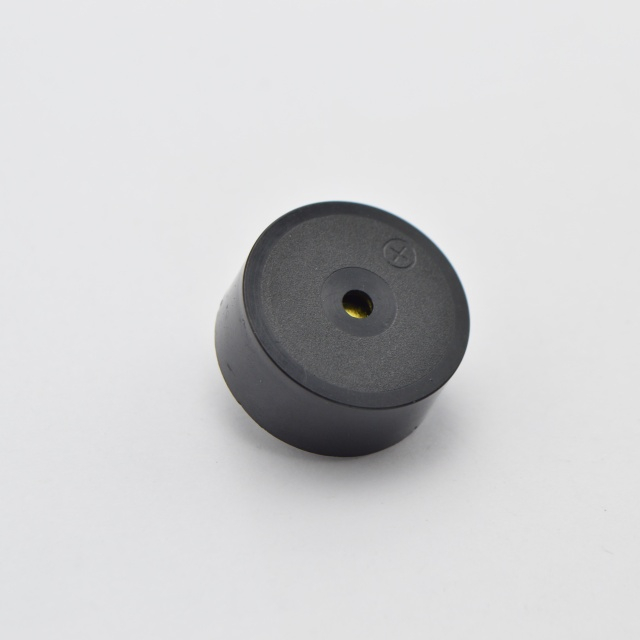
A buzzer is one of the few components where the acoustic result depends almost entirely on how the element and the cavity were put together. The same 23 mm × 10 mm envelope, the same 12 VDC rating and the same 3500 Hz centre frequency can be produced by sintering your own ceramic discs, or by buying discs from a third party and assembling them into a bought-in housing.
Those are two different businesses with two different failure modes. The assembler can hit a sample spec and still drift on batch five, because the drift comes from a supplier it does not control. The element maker can hold the band, but may not be set up for the small runs a new product needs. Neither is disqualifying — the point is that you cannot tell which one you are talking to from a catalogue page.
This is the single most revealing question. A manufacturer that prepares, forms and sinters its own discs controls the parameter that sets resonant frequency. A trader or assembler buys that control in, which is fine until the incoming discs shift and the finished buzzer drifts with them.
A good answer names the process steps — ceramic preparation, forming, sintering, electrode application — and can tell you how the element is matched to the housing. A weak answer describes the finished part only.
On the BPC2310 the published figure is a minimum of 90 dB at 10 cm when driven at 12 VDC. Those three conditions — distance, drive voltage and measurement setup — are part of the number, not footnotes. A rating taken at 10 cm and one taken across a room are not comparable, and a figure taken at 15 VDC says nothing about behaviour at 6 VDC.
Ask for the test conditions in writing, and ask whether the measurement is made in a free field, in a baffle or in a small chamber. If the answer is vague, the number on the quotation is not a specification, it is marketing. The IEC 61672-1:2013 description of sound level meters is useful background here, and the NIST Physical Measurement Laboratory publishes the measurement science behind the reading.
For a potted or sealed part, the assembly step is where yield is won or lost. The BPC2310 uses a black PBT housing with a centre sound hole, and the questions that matter are unglamorous: is potting done in-house, is it a manual or dispensed process, and how is the cure checked?
Ask what happens to units where the potting is short or the pin insertion is crooked. A manufacturer that can describe the reject handling has usually thought about the process; one that answers "we have good QC" has not.
The BPC2310 is specified at 3500 ± 500 Hz. A band that wide is honest — it is what a production population actually does — but it hides the distribution inside it. Two factories can both meet ±500 Hz while one ships mostly at the centre and the other ships a bimodal spread that makes your enclosure behave differently from unit to unit.
Ask whether frequency is tested 100% or sampled, and whether per-batch records are available. A factory that tests every unit can answer in minutes; one that samples will want to talk about averages, which is the tell.
This part is rated for -20 °C to +70 °C operation and -30 °C to +80 °C storage. Those are two different promises, and a supplier should be able to explain the difference: storage covers a non-operating part sitting in an unheated warehouse, operation covers a part that has to produce its rated output while the housing is cold or hot.
If a supplier quotes a single "temperature range", ask which one it is. Blurring the two is common and it is exactly the gap that shows up in a field return from a cabinet that bakes in summer.
Samples are frequently hand-assembled. Production is not. The honest answer describes what is different: tooling, fixtures, plating on the pins, the reel or tray, and the first-article inspection that closes the gap.
Ask for the MOQ, the tooling charge if any, and the production lead time next to the sample lead time. If the sample came in a week and production is quoted at eight, that is not a problem — it is information you need before you commit a launch date.
This is the question most buyers ask last, and it is the one that decides whether a supply relationship survives its first bad month. You want three commitments: batch traceability back to the production run, a stated returns path with a response time, and change notification when anything in the process or the bill of materials moves.
A manufacturer with an internal change-control process will answer this without hesitation. A trading desk usually forwards the question to someone else, which is itself the answer.
| As quoted | What it proves | What it does not tell you |
|---|---|---|
| 90 dB minimum at 10 cm | Output at one stated drive point | Behaviour at the low end of the 6 – 15 VDC range |
| 3500 ± 500 Hz | The tolerance band exists | Where inside the band your units will sit |
| 15 mA maximum at 12 VDC | Steady-state current budget | Switch-on inrush in your drive circuit |
| -20 °C to +70 °C operation | A rated operating window | What happens just outside it |
| PBT housing, ~3 g | Material and mass | Wall thickness, potting method, assembly yield |
| Through-hole pins | Mounting style | Pin retention force, plating, coplanarity |
Read the table as the minimum a supplier has agreed to, then use the seven questions to find out how they hold it.
A figure with no test conditions. If 90 dB appears without a distance and a drive voltage, you cannot compare it to anything, including the previous supplier's number.
"Equivalent to" with no drawing. Equivalence claims are only checkable against a dimensional drawing with tolerances. Without one, pin pitch and height become your problem after the first batch.
A datasheet that disagrees with the drawing. When the two differ, stop and ask which one governs the inspection. A supplier who cannot answer is telling you the documents are decorative.
The seven questions are not a test of politeness — each one maps to a way a buzzer programme fails later: a drifting element, an unmeasurable loudness claim, a potting step nobody owns, a frequency spread that moves your enclosure resonance, a blurred temperature promise, a sample that production never repeats, and a batch with no traceability behind it.
Used as a worked example, the BPC2310 shows what the answers should look like on paper: 23 mm × 10 mm, 12 VDC rated across 6 – 15 VDC, 15 mA maximum, 90 dB at 10 cm, 3500 ± 500 Hz, -20 °C to +70 °C. Compare it against the BPC2410 24 mm piezo buzzer if you need more output from a larger body, or the BP1230S SMD piezo buzzer when the board needs a reflow part instead of pins. The full range, sorted by mounting type, is on the buzzer category page, and the BPC2310 product page carries the complete specification table.
No. Size matters less than whether the process step that sets your critical parameter is inside the building. A small factory that sinters its own elements and tests every unit can be more predictable than a large assembler that buys discs on the open market.
Enough to see a distribution, not just a good unit. Test across the voltage window rather than at the rated point only — on this part that means checking output at 6 VDC and 15 VDC as well as at 12 VDC — and test in the enclosure you will actually ship, because the cavity changes the result.
An active part carries its own oscillator, so a DC supply produces a continuous tone; the BPC2310 is specified as a continuous-tone active buzzer for exactly that reason. What it still needs is a supply that stays inside its voltage window, which is where the 6 – 15 VDC rating does its work.
Convert both to the same distance and drive voltage, or ask each supplier to re-measure under identical conditions. If one cannot, treat its number as unverified rather than assume it is comparable — the same trap that makes loudness claims across suppliers so unreliable.


