
English 
Dedicated to global electroacoustic technology.
Views: 0 Author: Site Editor Publish Time: 2026-11-20 Origin: Site


A silent status LED is easy to ignore during a power failure. A sharp tone is not — which is why alarm panels, door contacts and instrument front panels still carry a small piezo buzzer even when everything else has moved to screens. The part has to be loud enough to cut through an air conditioner, quiet enough on current to survive a battery-backed rail, and small enough to drop into a layout that was drawn years ago.
The BP1470B-4001 14mm Piezoelectric Ceramic Buzzer answers that brief with a standard Φ14.0 mm footprint: a 4 kHz passive element, a potted top, and two through-hole pins on a 7.6 mm pitch. This article walks through its figures, why they matter at the panel level, and the one requirement that catches first-time users — it has no drive circuit of its own.
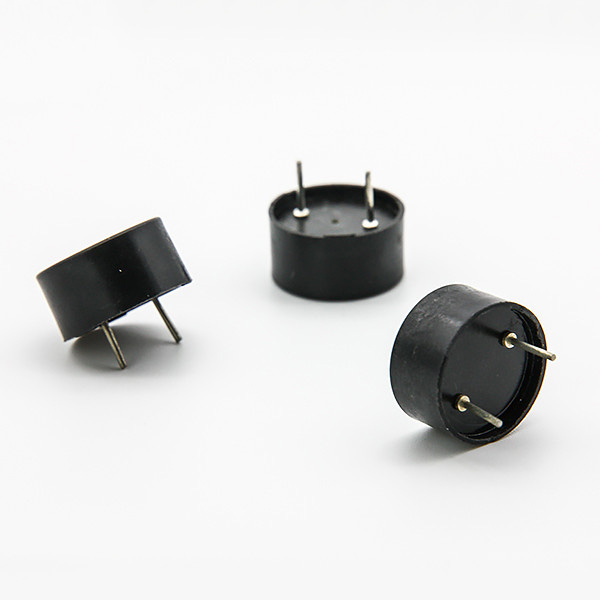
| Parameter | Specification |
|---|---|
| Body | Φ14.0 ± 0.2 mm diameter × 7.0 ± 0.2 mm height |
| Mounting | Two through-hole pins, Φ0.7 ± 0.1 mm, 6.0 ± 0.5 mm long, 7.6 ± 0.2 mm pitch |
| Resonant frequency | 4000 ± 500 Hz |
| Operating voltage | 1 – 25 Vp-p |
| Rated current | ≤ 5 mA at 4 kHz, 50% duty square wave, 12 Vp-p |
| Sound output | ≥ 85 dB at 10 cm, at 4 kHz 50% duty, 12 Vp-p |
| Element capacitance | 1200 ± 30% pF at 120 Hz |
| Top | Potted seal with a centre sound hole |
| Operating temperature | -20 °C to +70 °C |
| Storage temperature | -30 °C to +80 °C |
| Net weight | Approximately 1.0 g |
| Parameter | Value | What it buys the design |
|---|---|---|
| Sound output | ≥ 85 dB at 10 cm | An alert that carries across a room without a second amplifier stage |
| Current | ≤ 5 mA | Backup batteries keep their reserve during an alarm event |
| Voltage | 1 – 25 Vp-p | One part covers 3.3 V logic and higher industrial rails |
| Sealing | Potted top, centre hole | Dust and moisture stay out of the ceramic element |
| Footprint | Φ14.0 mm, 7.6 mm pitch | Drops into existing 14 mm layouts |
At 12 Vp-p on a 4 kHz square wave the part is rated at 85 dB or better at 10 cm. That figure is measured at a stated distance and drive level, so it is only comparable to a competitor's number if the test conditions match — the IEC 61672-1:2013 description of sound level meters explains why two benches can disagree on the same part, and the NIST Physical Measurement Laboratory publishes the measurement background behind the reading.
The 4 kHz centre frequency is the practical half of the story. Most room noise — fans, compressors, traffic — sits lower, so a tone up here stays audible at moderate output instead of being masked.
A rated current of 5 mA or less at 12 Vp-p is the figure that matters during a mains failure, when the panel is running on a sealed battery. It also means the part can often be driven from a logic-level output through a small transistor rather than a dedicated amplifier, which removes a component and a rail from the BOM.
Door contacts, entry panels and warehouse units live where nobody controls the humidity. The epoxy-potted top seals the ceramic element behind a centre sound hole, so dust and moisture do not settle directly on the vibrating disc. That is a construction detail rather than a rating — the operating window is -20 °C to +70 °C, with storage down to -30 °C and up to +80 °C, so the part is suited to semi-outdoor cabinets rather than full weather exposure.
A 1 – 25 Vp-p operating range means the same buzzer works on a logic-level rail and on a higher industrial bus. In practice that collapses two or three stock lines into one, and it lets a single board design serve both a low-voltage variant and a higher-voltage variant without a re-spin.
At roughly 1.0 g with no moving parts beyond the ceramic disc, the part tolerates shipping shock and board-level vibration well. The two pins are wave-solder friendly, which keeps it inside an existing through-hole process instead of forcing a reflow step.
This is a passive piezoelectric element with no internal oscillator. Apply a DC level and the diaphragm shifts once — a click, not a tone. The buzzer needs an external square wave, and the drive frequency should sit at 4 kHz with a duty cycle near 50%, because that is the condition the 85 dB and 5 mA figures are quoted under.
Two practical consequences. First, a firmware pin that stays high is not an alarm; the tone is generated in software or in a dedicated oscillator, and the symptom of a missing drive looks exactly like a dead buzzer. Second, the drive amplitude sets the volume: staying within 1 – 25 Vp-p and raising the peak-to-peak voltage is the intended way to get more output, not adding a second sounder.
If the design cannot spare an oscillator or a PWM channel, an active part with built-in circuitry is the simpler answer — the BPC2310 23 mm active piezo buzzer is the same family with the drive stage inside.
The mechanical drawing is the part of the specification worth checking first: Φ14.0 mm body, 7.0 mm height, two pins at 7.6 mm pitch and 6.0 mm long. Those are the numbers that decide whether a drop-in replacement actually drops in, and they are the ones most often left out of a competitor's summary.
If the board has room but the height is tight, the BP1770C-0540 17 mm passive piezo buzzer uses the same passive drive logic at a different diameter. For the full range of through-hole and SMD options, the buzzer category page lists them by mounting type, and the BP1470B-4001 product page carries the complete specification table.
A 14 mm piezo buzzer survives in security hardware because it solves three problems at once: enough output to be heard, low enough current to run from a backup battery, and a footprint that fits boards designed a decade ago. The BP1470B-4001 covers those with 85 dB at 10 cm, 5 mA at 12 Vp-p and a potted Φ14.0 mm body. The only real design obligation is the drive signal — a 4 kHz square wave near 50% duty, generated outside the part.
No. DC produces a single click. The element needs an alternating signal, typically a 4 kHz square wave from a PWM pin or a small oscillator, within the 1 – 25 Vp-p range.
Raise the peak-to-peak drive voltage within the rated 1 – 25 Vp-p window and keep the drive at the 4 kHz resonance with a duty cycle near 50%. Both the 85 dB output and the 5 mA current are quoted under those conditions.
The potted top keeps dust and moisture off the ceramic element and the operating range reaches +70 °C, which suits covered entry panels and semi-outdoor cabinets. It is a potted construction, not a sealed outdoor rating, so full weather exposure still needs housing protection.
Four numbers: Φ14.0 mm diameter, 7.0 mm height, 7.6 mm pin pitch and 6.0 mm pin length. Check those against the existing footprint before comparing sound figures.


