
English 
Dedicated to global electroacoustic technology.
Views: 0 Author: Site Editor Publish Time: 2026-10-22 Origin: Site


Choosing an alarm buzzer comes down to four decisions, and only the first one is about sound. You pick the drive technology, because a piezoelectric element and an electromagnetic coil behave completely differently on your power rail and in your EMC test. You pick the drive configuration, because an active buzzer needs only a DC level while a passive one needs a waveform from your firmware. You pick the acoustic parameters, which are meaningless without a stated distance and a stated drive voltage. And you pick the mechanical interface, which is what actually decides whether the alarm is still working eighteen months into the field. Get the last two wrong and a buzzer that measured 95 dB on the bench turns into a warranty claim. This guide works through all four.
Drive technology sets your current budget and your EMC risk: A piezoelectric buzzer is a solid-state ceramic element with no coil, so it draws very little current and radiates almost nothing. An electromagnetic buzzer uses a coil and a moving diaphragm, which costs more current and adds an inductive load you have to manage.
Active versus passive is a firmware decision, not a quality decision: Active buzzers contain their own oscillator and sound as soon as they see DC. Passive buzzers are transducers only, and produce nothing until your MCU supplies a square wave at the right frequency.
A sound pressure figure without a distance and a drive voltage is not a specification: Catalogue numbers are quoted at 10 cm or at 30 cm, at a rated voltage or at a drive level. Comparing two buzzers quoted under different conditions is the most common sourcing mistake in this category.
Resonant frequency matters more than peak loudness: Every piezo and magnetic buzzer is loudest at its resonant point and falls away quickly either side. A buzzer driven off resonance can lose several dB while drawing the same current.
The mechanical interface determines field life: SMD parts are only as strong as their solder joints, pin-mount parts survive vibration better, and panel-threaded parts with epoxy sealing are the only realistic choice for washdown, outdoor or machine-mounted positions.
A siren is a different product, not a louder buzzer: Sirens use horn loading and much higher input power to cover distance. If your requirement is "audible across a yard" rather than "audible at the operator panel", the specification changes completely.
An alarm buzzer is a self-contained electroacoustic signalling device designed to produce a warning tone rather than reproduce audio. That definition matters, because it explains the design priorities: an alarm buzzer is optimised for audibility, consistency, current consumption and mechanical survival, in roughly that order. Bandwidth, distortion and bass response are not on the list.
Inside the housing there is always the same three-part chain: a driving circuit, an acoustic element, and a resonant cavity that couples the element to the air. Everything that varies between products comes from those three parts. Change the acoustic element and you change current draw, frequency band and EMC behaviour. Change the driving circuit and you change whether the part needs firmware support. Change the cavity and housing and you change both the sound output and the environmental rating.
Two practical consequences follow. First, the acoustic element and the drive configuration are independent choices — there are active piezoelectric buzzers, passive piezoelectric buzzers, active electromagnetic buzzers and passive electromagnetic buzzers, and they are genuinely different products. Second, the housing is not packaging. A 43 mm panel-threaded, epoxy-sealed body and a 9 mm SMD part can use the same ceramic element and still behave like completely different components in the field.
For a full view of the formats available within one supplier, the buzzer range TAT manufactures spans SMD, pin-mount, wire-lead and panel-threaded bodies across both technologies.
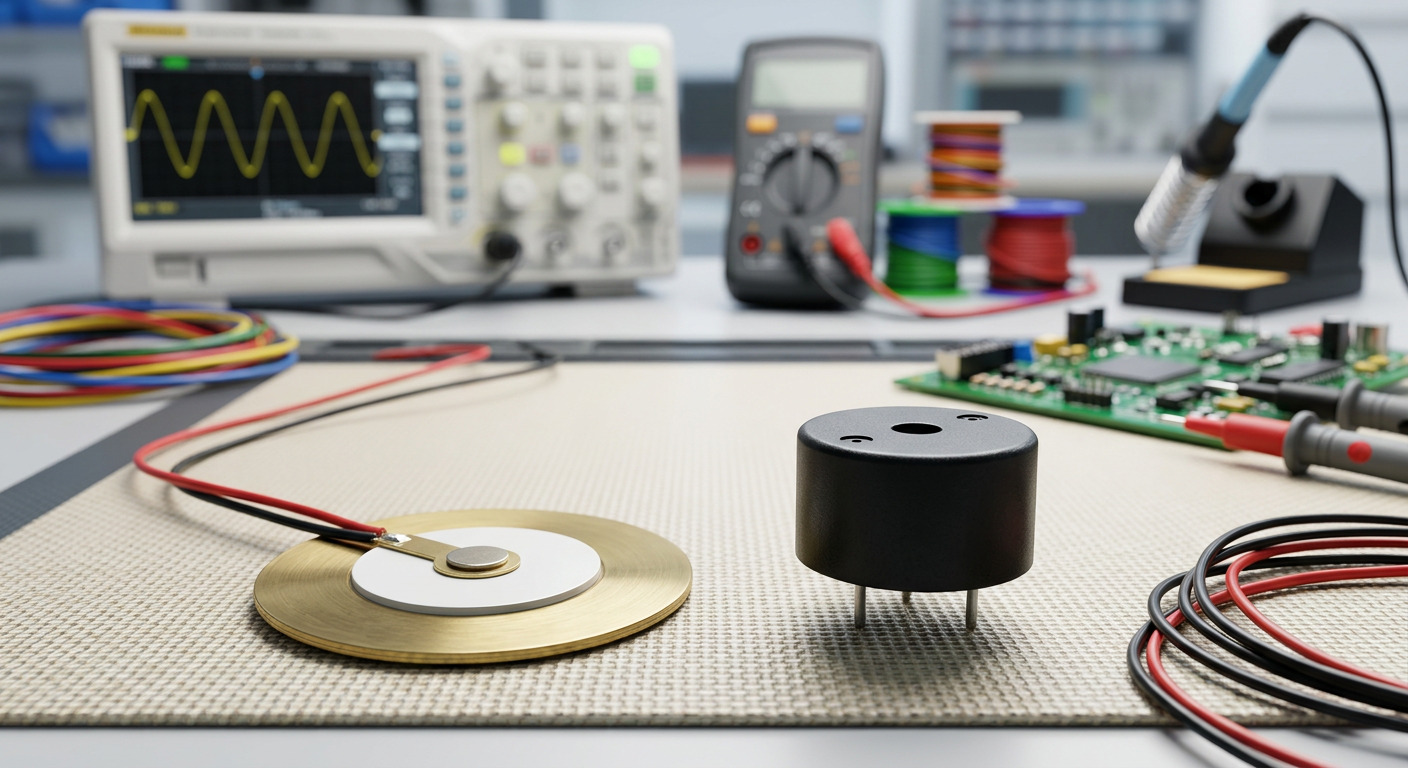
This is the choice that constrains everything downstream. A piezoelectric buzzer uses a ceramic disc bonded to a metal plate; apply a voltage and the disc deforms, and the assembly flexes at audio rate. An electromagnetic buzzer drives a coil that pulls and releases a ferromagnetic diaphragm.
Table 1: Piezoelectric vs Electromagnetic Drive Technology
Parameter | Piezoelectric buzzer | Electromagnetic buzzer |
|---|---|---|
Sound-generating element | Ceramic disc on a metal plate, solid state | Coil plus moving ferromagnetic diaphragm |
Moving parts | None | Diaphragm travels on every cycle |
Typical current draw | Low, often a few mA | Higher, tens of mA |
Operating voltage | Wide, commonly up to 28 V DC or Vp-p | Narrow and low, typically 1.5–12 V DC |
Typical resonant band | 2.5–3.5 kHz | 1–3 kHz |
EMI signature | Negligible, no coil | Local magnetic field, needs layout care |
Wear mechanism | Essentially none | Diaphragm fatigue and coil degradation |
A piezoelectric element is a capacitor that changes shape. The ceramic is poled so that an applied field produces a strain, and because the disc is bonded to a brass or stainless plate, the strain becomes bending. Drive it with an alternating voltage and the plate flexes, pushing air. There is no gap, no magnet and no coil anywhere in the acoustic path.
That construction explains the two properties engineers care about most. Current draw is low because the element is capacitive: it takes charge to move it, but it does not pass a continuous DC current. And the current scales with frequency times capacitance, not with output level in the way a coil does. A representative part is the BPC2316-2431 24 V piezo buzzer, a 23 × 16 mm active unit rated 24 V DC with a 5–28 Vp-p operating window, a maximum of 30 mA at 24 V, a minimum of 95 dB at 10 cm, and a resonant frequency of 3100 ± 500 Hz.
Absence of a coil also means absence of a magnetic radiator. A piezo buzzer can sit next to a radio module, a Hall sensor or a high-impedance analogue front end without the shielding a coil would force you to add.
Electromagnetic buzzers win in two situations: low supply rails and low frequency content. A coil produces usable output at 1.5–12 V, which fits directly onto 3.3 V and 5 V logic rails and onto automotive accessory supplies. And the moving-diaphragm mechanism is naturally suited to the 1–3 kHz region, which many designers prefer for a softer, less piercing alarm than a 3 kHz ceramic.
The cost is current and care. A coil drawing tens of milliamps cannot be driven straight from a GPIO pin, so you need a transistor and a flyback diode across the coil to absorb the inductive spike when the driver turns off. Layout also has to respect the magnetic field: keep the buzzer and its current loop away from sensitive analogue traces and from any magnetic sensing, and decouple the driver locally. In exchange you get a mechanically simple, inexpensive, low-voltage part with a well-established sound character.
Drive configuration is independent of drive technology, and it is the difference between a component your firmware can ignore and one your firmware has to generate.
An active buzzer contains its own oscillator. Apply a DC voltage within the rated window and it produces a continuous tone at its design frequency. A passive buzzer is the transducer alone: it has no oscillator, so the frequency, duty cycle and envelope all come from the signal you supply.
It removes the waveform generator, and with it a timer channel, an interrupt budget and any risk that the tone frequency drifts when you change your clock tree. It also removes the need to know the resonant frequency of the part: the manufacturer has already tuned the drive to it.
The BPC2312W100-1235 12 V active piezo buzzer is a good illustration of what an active part looks like in a specification table: 12 V DC rated with an 8–15 V range, current at or below 20 mA, output above 95 dB at 10 cm, and a continuous tone at 3500 ± 500 Hz. Nothing in that list requires your firmware to do anything except switch a rail. Wire leads and a 4.2 g body make it a drop-in for control panels and security housings.
The trade-off is inflexibility. An active buzzer has one tone. If the product needs two distinct alerts — say a soft acknowledgement and a hard fault — you either fit two parts or move to a passive design.
A passive buzzer is worth it whenever the tone itself carries information or needs tuning. Multi-stage alarms, distinguishable fault versus warning patterns, and applications where you want to sweep the drive frequency to find the loudest point in the assembled enclosure all require a passive part.
There is a second, less obvious reason: a passive piezo can be driven at a frequency chosen to match the acoustic cavity of your product rather than the cavity the supplier tested in. In a tight housing, the free-air resonant frequency is not where the assembled unit is loudest, and being able to move the drive frequency by a few hundred hertz often recovers more output than switching to a louder component.
Two cautions. Passive piezo elements are capacitive, so the driver must both source and sink charge — a push-pull stage or a bridge, not a single-ended switch. And a passive element driven at DC produces nothing at all, which sounds obvious but is a frequent bring-up failure when a passive part is substituted for an active one without changing the firmware.

Table 2: Reading the Three Acoustic Parameters Together
Parameter | What it tells you | What it does not tell you |
|---|---|---|
Sound pressure level (dB) | Output at one stated distance at one stated drive level | Output at any other distance, or in your enclosure |
Resonant frequency (Hz) | Where the element is most efficient | How wide the usable band is around it |
Operating voltage (V DC or Vp-p) | The drive window the output was measured in | Whether the part is loud enough at your rail's minimum |
Always with a distance and a drive condition attached. A figure of "95 dB" is not a specification; "minimum 95 dB at 10 cm, at 24 V DC" is. The difference is not academic — a part quoted at 10 cm and a part quoted at 30 cm differ by roughly 9.5 dB for the same physical output, because sound pressure falls about 6 dB per doubling of distance.
Matching the number to the application then follows a simple pattern. A gentle indoor alert can sit in the 60–85 dB band. An alarm that has to be heard over machinery, in a plant room or on a vehicle needs the upper 80s and above, measured at a distance that reflects where a person actually stands. For outdoor or wide-area coverage, no buzzer is the right answer — see the siren discussion below.
One more discipline: check the current and the output at the same drive voltage. A piezo quoted at 24 V will not deliver its catalogue SPL on a 12 V rail, and the shortfall is larger than most engineers expect.
Because a buzzer is a mechanical resonator, not a broadband source. Output peaks sharply at resonance and falls away on both sides, so the difference between driving at resonance and driving a few hundred hertz away can be several decibels at identical current. The practical rule is to choose a part whose resonant band sits inside the range your drive circuit can actually produce, and then drive it there.
That also explains why the two technologies sound different even at equal loudness. A piezo part at 2800–3500 Hz sits in the region where human hearing is most sensitive, which is why it reads as penetrating and urgent. A magnetic part at 2000–2700 Hz reads as fuller and less shrill. Neither is better; the choice depends on whether you want the alarm to startle or to inform.
A waterproof M27 panel-mount piezo buzzer such as the BPC43M-1228-SP shows how these numbers present on a sealed part: 12 V DC rated across a 6–28 V DC operating range, a maximum of 30 mA at 12 V, a minimum of 95 dB at 10 cm, and a continuous 2800 ± 500 Hz tone in a 43 mm body.

Table 3: Mounting Styles and What They Survive
Mounting style | Typical position | Mechanical strength | Environmental sealing |
|---|---|---|---|
SMD | High-density PCB inside a sealed enclosure | Limited by the solder joint | None; relies on the host enclosure |
Pin mount (through-hole) | Standard industrial boards, power boards | Better, pins carry vibration into the board | None; conformal coating only |
Wire leads | Control cabinets, remote positions | Flexible strain relief, routing freedom | Depends on the housing, not the leads |
Panel threaded (e.g. M27) | Machine panels, outdoor and washdown areas | High, locked by a threaded nut | Good, with an epoxy-sealed body and gasket |
The pattern is that sealing is a property of the housing, not of the acoustic element. A piezo disc is reasonably tolerant of humidity, but the terminals and the drive circuit behind it are not, and water entering the cavity changes both the resonant frequency and the output long before the part fails outright.
For anything mounted on the outside of a machine, in a washdown area or in an outdoor enclosure, specify a panel-threaded body with an epoxy-sealed rear and a sealing gasket, and confirm the thread size against the hole you have already cut. M27 is a common panel standard for 43 mm bodies. For interior boards, pin mount is the reasonable default: it is more tolerant of vibration than SMD and far easier to rework, at a modest cost in board area.

A siren is not a louder buzzer. It is a different architecture: a high-power driver coupled to a horn, which matches the driver to the air far more efficiently in one direction and produces far higher output at distance. That is why sirens are specified for evacuation, outdoor perimeter warning and wide-area plant alerting, and why they consume hundreds of milliamps to amps rather than tens of milliamps.
The decision is about coverage geometry. If the requirement is "audible at the operator panel" or "audible within two metres of the machine", a panel buzzer at 95 dB at 10 cm is the correct, cheap, low-current answer. If the requirement is "audible across a yard" or "audible over the noise of the process from any point on the floor", a buzzer will not get there no matter how you drive it, and the specification needs to move to a horn-loaded device with its own power budget and mounting.
There is a middle case worth naming: an alarm that must be heard over continuous machinery noise but only locally. Here the answer is usually a higher-output piezo in a properly sealed panel body plus careful choice of resonant frequency, not a siren.


Security and access control is the highest-volume application. Door alarms, access-control readers, intruder panels and gate controllers all use an active buzzer switched directly from a rail or a driver transistor. The requirements are a single unmistakable tone, low current so the standby battery is not compromised, and a housing that suits the enclosure.
Industrial control and machine safety is where sealing and mounting dominate. Panel-threaded, epoxy-sealed buzzers appear on machine fronts, forklift and vehicle reverse alarms, control cabinets and automated warning systems, chosen because the mounting survives vibration and the body survives coolant and washdown.
Medical and laboratory equipment is where EMI and predictability dominate. A coil-free piezo part can sit inside a device without compromising its own sensitive front end, and a fixed active tone means the alarm does not depend on firmware timing. Infusion pumps, patient monitors, ventilators and diagnostic instruments all fall into this group.
Consumer and appliance applications use the same parts at far higher volume: hand-sanitizer dispensers that confirm a dispense with a short beep, smart locks, coffee machines and white goods. Here the driver is usually a GPIO through a small transistor, the tone is fixed, and the whole specification is cost, current and consistency.
Across all four, the OEM/ODM levers are the same: wire length and connector, the tone frequency within the element's capability, the housing and thread, and the sealing method. If you are sourcing for a specific enclosure, the piezo buzzer range is the place to start matching body size to available panel area.
Work through five questions in order, and the specification usually writes itself.
First, what is your supply rail? A 3.3 V or 5 V rail points to an electromagnetic part or a low-voltage piezo; a 12 V or 24 V rail opens up the whole piezo range and its much lower current draw. Second, does the alarm need more than one tone? If yes, the part must be passive and your firmware must generate the waveform. If no, an active part removes a whole class of failure. Third, what is the noise environment and where does the listener stand? That fixes the required SPL and, critically, the distance at which it is specified. Fourth, how is the part mounted and what does it have to survive? Panel-threaded and epoxy-sealed for anything exposed; pin mount inside a sealed enclosure. Fifth, does anything sensitive sit nearby? If a radio, a Hall sensor or a high-impedance front end is within a few centimetres, prefer the piezo part and avoid the layout problem entirely.
In most industrial projects the resulting default is an active piezoelectric buzzer, 12 V or 24 V, in a sealed panel-threaded body, at a resonant frequency between 2800 and 3500 Hz. The engineering effort then goes where it belongs: sealing, mounting torque and panel cut-out tolerance, rather than the acoustic design.
The four differences that decide an alarm buzzer are drive technology, drive configuration, acoustic parameters and mechanical interface. Only the third is about sound, and even that one is meaningless unless the sound pressure figure carries its distance and drive voltage with it.
The reliable way to specify is to work from the environment inward. Fix the supply rail, decide whether the firmware can afford to generate a waveform, then set the SPL from the noise level and the listener's position, and finally choose a body that survives the mounting position. Projects that fail in the field almost always got the last step wrong while getting the datasheet right.
Before you release the part number, confirm five things in writing with your supplier: the sound pressure level with its distance and drive voltage, the resonant frequency and its tolerance, the current at your actual rail, the mounting thread and sealing method, and the RoHS documentation for the exact variant you are buying. These are the five values most often left ambiguous in catalogue copy, and the five that decide whether the alarm is still working a year after installation.
Ready to specify an alarm buzzer for a panel, a machine or a new enclosure? TAT Electronics manufactures piezoelectric and electromagnetic buzzers in SMD, pin-mount, wire-lead and panel-threaded formats, with epoxy-sealed bodies, M27 threads and custom wire assemblies available. Send your supply rail, target SPL with its distance, mounting thread and environmental requirement through our contact page and we will come back with the closest matching part and a sample plan.
A: A piezoelectric buzzer generates sound with a ceramic disc bonded to a metal plate; applying a voltage deforms the disc and the assembly flexes at audio rate, with no moving parts and no coil. An electromagnetic buzzer drives a coil that pulls and releases a ferromagnetic diaphragm. In practice the piezo part draws far less current, works across a much wider voltage range such as 5–28 V, sits naturally in the 2.5–3.5 kHz band, and radiates almost no magnetic field. The magnetic part works at low voltages of 1.5–12 V, sits in the 1–3 kHz band, draws tens of milliamps, and requires a transistor driver with a flyback diode.
A: Choose active if the product needs one fixed warning tone. An active buzzer contains its own oscillator, so applying DC within the rated window produces the tone with no firmware involvement and no timer resource. Choose passive if the tone carries information — multiple alert stages, distinguishable fault patterns — or if you need to tune the drive frequency to the acoustic cavity of your finished enclosure. Passive parts are capacitive and need a driver that both sources and sinks charge, usually a push-pull stage or a bridge.
A: Convert the catalogue figure to your own conditions before comparing anything. A sound pressure level is only valid with the distance and the drive voltage stated alongside it, because output falls by roughly 6 dB for every doubling of distance and a piezo quoted at 24 V will not reach that figure on a 12 V rail. Establish the ambient noise at the listener's position, add the margin your application needs, then pick a part whose stated figure is measured at the same distance and at or below your actual rail voltage.
A: Specify a panel-threaded body with an epoxy-sealed rear and a sealing gasket, and confirm the thread against your existing panel cut-out — M27 is a common standard for 43 mm bodies. Sealing is a property of the housing rather than of the acoustic element: a piezo disc tolerates humidity reasonably well, but water reaching the terminals or the drive circuit changes the resonant frequency and the output long before the part fails outright. For interior boards inside a sealed enclosure, pin mount is the practical default because it tolerates vibration better than SMD and is far easier to rework. Non-sealed bodies rely on the host enclosure for protection.
A: When the requirement is coverage of an area rather than an alert at a specific position. A panel buzzer rated at 95 dB at 10 cm is the right answer for "audible at the operator panel"; a siren is the right answer for "audible across a yard" or "audible anywhere on the plant floor over process noise". A siren uses a horn-loaded high-power driver, which couples far more efficiently to the air in one direction and draws hundreds of milliamps to amps instead of tens of milliamps. That changes the power budget, the mounting and the certification scope, so it is a different specification rather than a louder version of the same one.


