
English 
Dedicated to global electroacoustic technology.
Views: 0 Author: Site Editor Publish Time: 2026-10-22 Origin: Site


Choosing between an electret condenser microphone and a true condenser comes down to three questions: who supplies the polarization voltage, how much space you have, and whether the recording is controlled enough to justify the extra cost. An electret capsule carries a permanent charge in its diaphragm or backplate and needs only a 1–10 V bias for its internal JFET, while a true condenser needs continuous 48 V phantom power to polarize the capsule. For compact, battery-powered products the electret wins almost every time; for studio capture the true condenser still sets the standard. This guide works through all five differences and the numbers behind them.
Polarization is the dividing line: An electret capsule holds a permanent charge and needs only 1–10 V to run its JFET. A true condenser needs continuous 48 V phantom power before it produces any signal at all.
The performance gap has narrowed, not closed: Modern electret capsules reach 20 Hz–20 kHz and competitive sensitivity, but true condensers still win on self-noise and transient accuracy in treated rooms.
Electrets are the more rugged choice: No high-voltage field across the capsule gap means far less vulnerability to humidity and condensation, the usual cause of capsule crackle in studio mics.
Size follows from the polarization method: A true condenser needs a large, heavy capsule and a shock mount. Electret capsules in TAT's EM series are as small as 6.0 × 2.7 mm and mount directly on a PCB.
Match the JFET output impedance before you tune anything else: ECM capsules present roughly 2.2 kΩ at the output. Get your preamp input impedance and bias network right, or you will chase noise that is really a loading problem.
Cost scales with assembly, not with the capsule: True condensers are hand-tensioned and individually calibrated. Electret capsules are built on automated SMD lines, which is why they dominate high-volume consumer products.
An electret condenser microphone (ECM) is an electrostatic capsule in which the electret material — a permanently polarized polymer — is integrated into the diaphragm or the backplate. Because the charge is stored in the material itself, the capsule needs no external high-voltage polarization supply. That single design choice is what makes the ECM small, cheap, and battery-friendly.
Sound waves striking the capsule move the diaphragm and change the distance, and therefore the capacitance, between diaphragm and backplate. The resulting charge variation becomes a very small voltage. The capsule's native impedance is extremely high — far too high to run down a cable — so an integrated JFET acts as an impedance converter and brings the output down to a usable level in the region of 2.2 kΩ.
Two parameters dominate the electrical design that follows. First, the bias resistor feeding the JFET sets both the operating point and, together with the capsule capacitance, the low-frequency corner. Second, the input impedance of whatever the capsule feeds must be substantially higher than the capsule's output impedance, or sensitivity drops and noise rises. You can browse the full range of electret condenser microphones TAT manufactures to see how widely capsule size and sensitivity vary within this one architecture.
Polar patterns are fixed at manufacture: an omnidirectional capsule captures evenly in all directions, while a unidirectional (noise-cancelling) capsule uses a rear acoustic port to reject sound arriving from behind. Choose the pattern with the mechanical design, not afterwards.
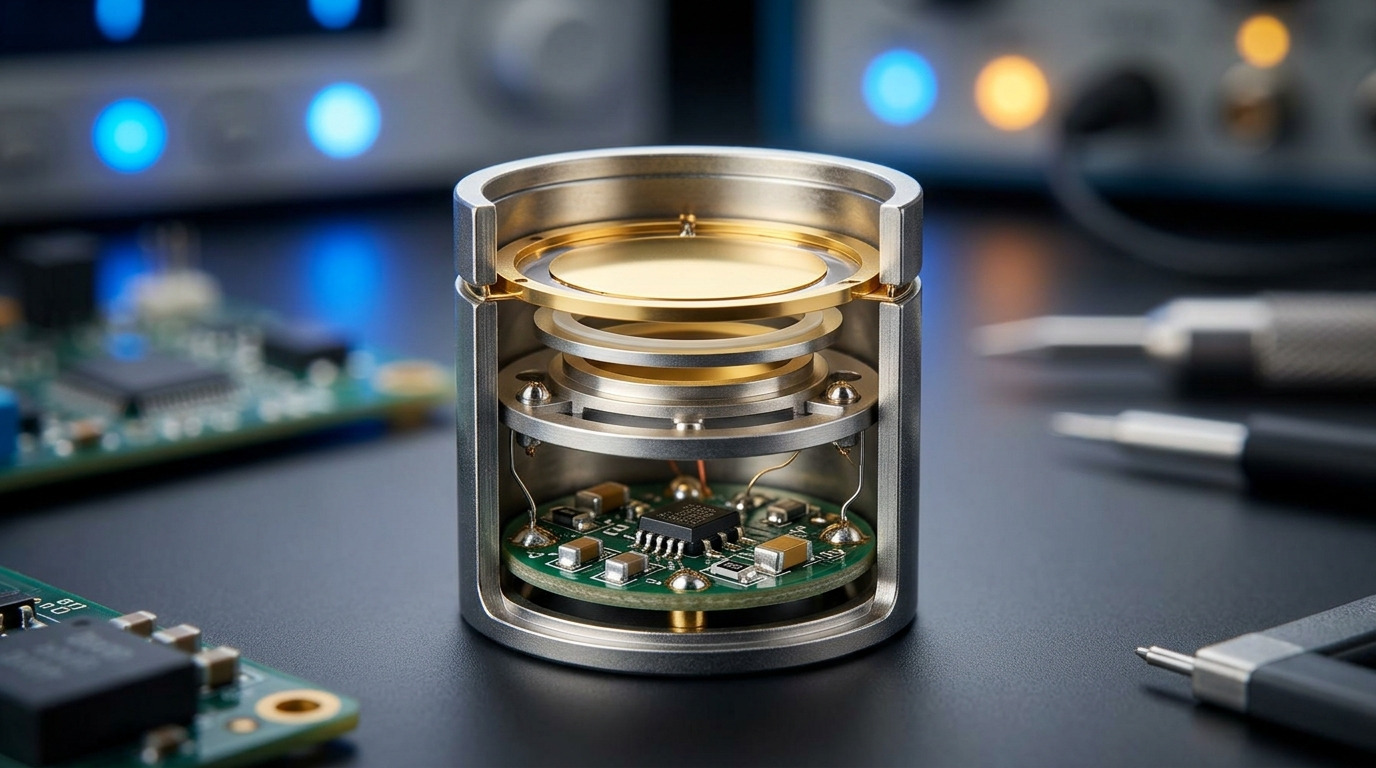
A true condenser microphone, sometimes called an externally polarized condenser, does not store its own charge. It relies on a continuous DC polarization voltage — usually 48 V phantom power from the preamp, interface or console — applied across the capsule. Remove that voltage and the microphone is silent, not merely quieter.
The capsule itself is a very thin, gold-sputtered diaphragm suspended close to a solid backplate. Because the diaphragm carries no electret layer, it can be made lighter than an electret diaphragm of the same diameter, and a lighter diaphragm accelerates more readily. That is the physical origin of the true condenser's reputation: fast transient response, extended high-frequency detail, and low self-noise.
The trade-offs follow from the same construction. The polarization field sits across a very small gap, so any moisture bridging that gap produces the crackle and sputtering that studio engineers know well. The capsule is also physically large and heavy, which forces a shock mount, a substantial body, and a fixed installation.
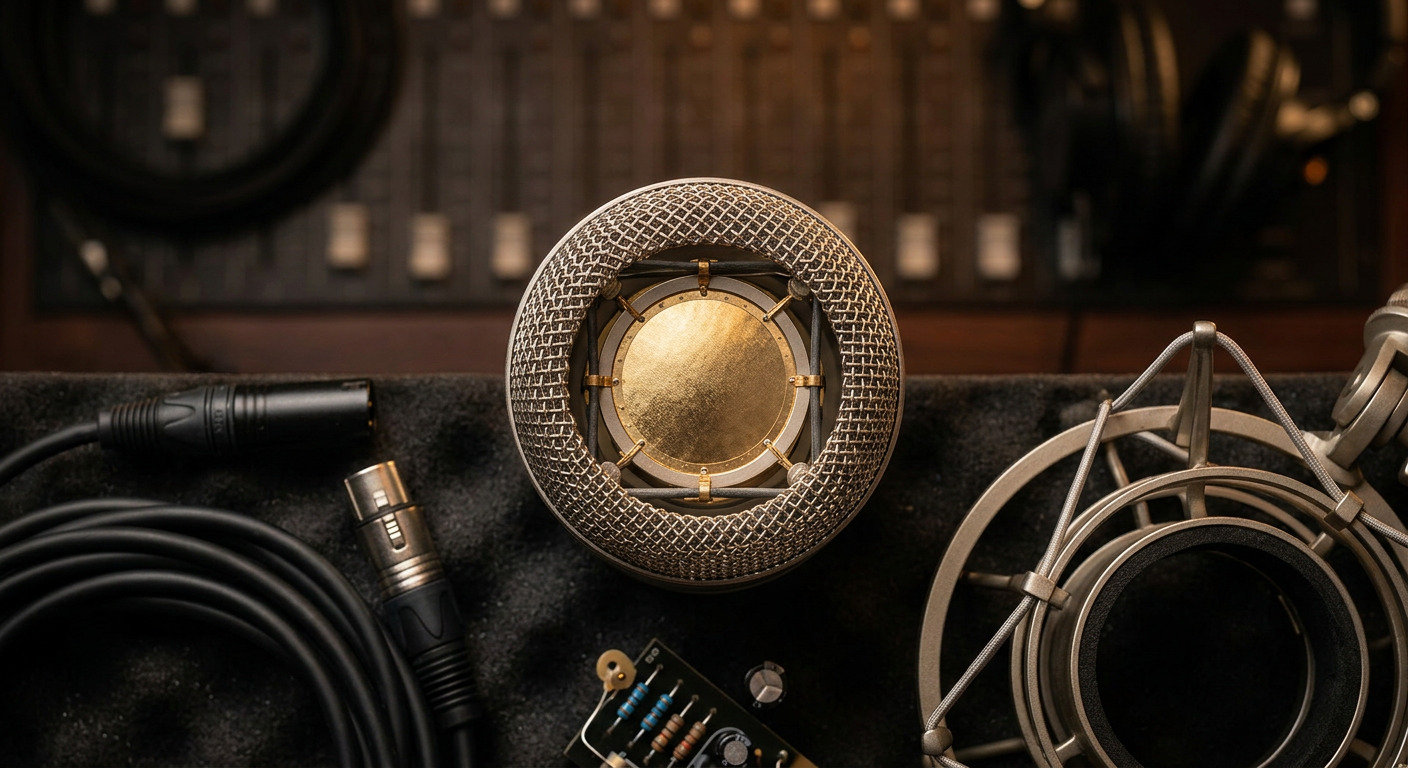
A true condenser is unusable without phantom power. This is not a preference; it is an electrical requirement, and it constrains the whole product: a 48 V rail, phantom-power compliance in the preamp, and usually balanced cabling.
An ECM replaces that requirement with a bias voltage of roughly 1–10 V whose only job is to operate the JFET. Current draw is in the tens to hundreds of microamps. This is why electret capsules appear in battery-powered products at all — the power budget simply allows it, where a phantom-powered capsule would not.
Table 1: Acoustic Parameters, True Condenser vs Electret Condenser Typical industry ranges for comparison; individual capsules vary and should be checked against the supplier's datasheet.
Parameter | True condenser | Electret condenser (ECM) |
|---|---|---|
Sensitivity | High, typically −40 to −32 dB | Competitive, typically −42 to −25 dB |
Frequency response | Wide and flat, 20 Hz to 20 kHz and beyond | 20 Hz to 20 kHz, commonly voice-optimized |
Self-noise | Very low, often below 10 dBA | Low to moderate, typically 15–25 dBA |
Transient response | Best in class, attributable to the lighter diaphragm | Good, limited by diaphragm mass and porting |
Polar patterns | Selectable, including multi-pattern | Fixed at manufacture (omni or uni) |
The honest summary is that the gap has narrowed on frequency response and sensitivity but remains on self-noise. For a voice prompt in a smart lock or an intercom, 20 dBA of self-noise is irrelevant. For a quiet acoustic instrument in a treated room, it is the difference between a usable take and a noisy one.
Moisture is the true condenser's weak point for a structural reason: its polarization field sits across a gap measured in tens of microns. Condensation from breath or a cold room bridging that gap produces popping, hissing and low-frequency sputtering, and in bad cases a permanent change in capsule behaviour. Temperature swings and mechanical shock can also shift a diaphragm that is only micrometres thick.
An ECM has no such gap to bridge, which makes it markedly more tolerant of humidity, and it can be built into sealed or waterproof housings. Suppliers commonly publish operating lives in the 30,000 to 50,000 hour range for electret capsules. Note that this is a durability figure, not an acoustic one — a rugged capsule and a low-noise capsule are different design targets.
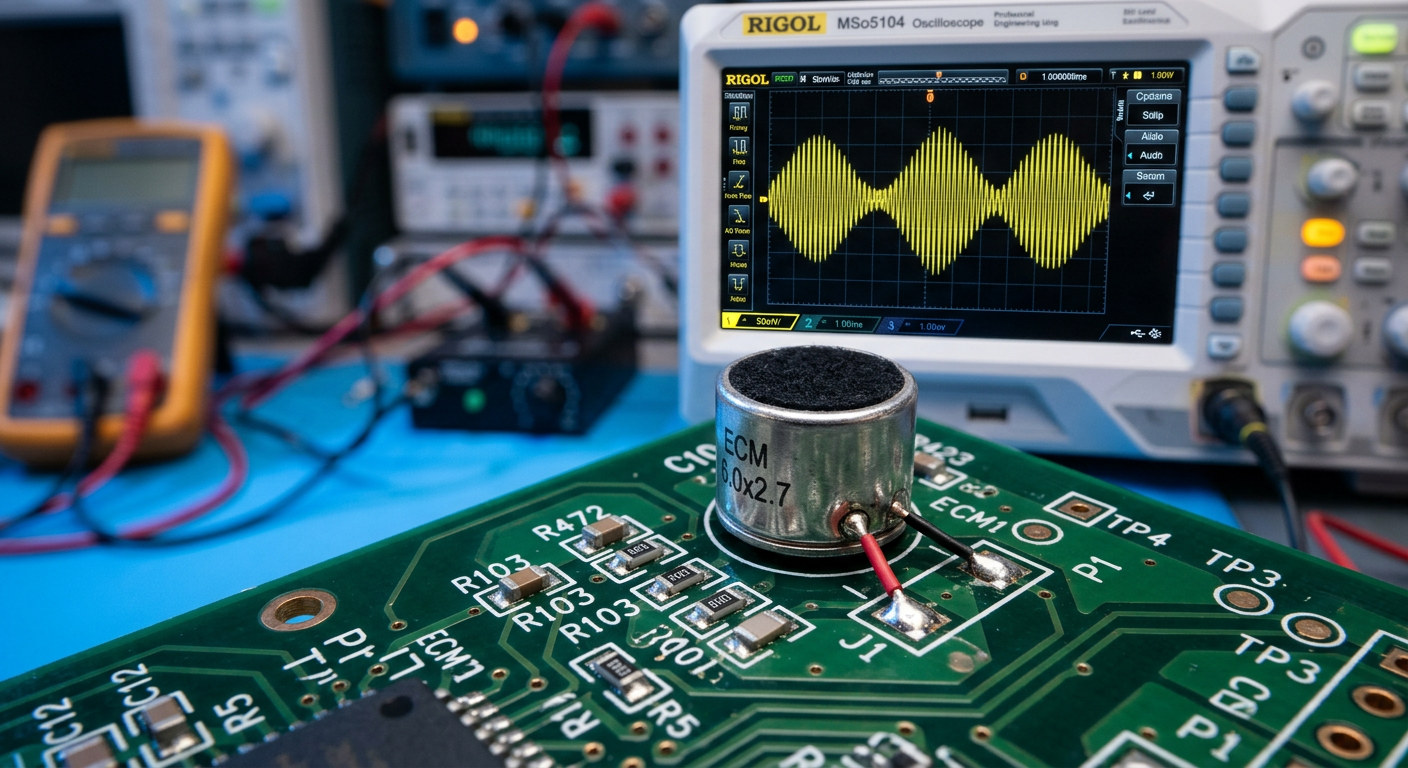
A true condenser capsule is large and heavy by necessity, and isolating it from handling noise requires a shock mount inside a substantial body. The result is a device that lives on a stand.
Electret capsules are available in footprints small enough to place beside other components on a PCB. In the TAT EM series the TAT-EM6027 measures 6.0 × 2.7 mm with pins for through-hole mounting, while the EM6050P-40dB uses a 6.0 × 5.0 mm package with a noise-cancelling characteristic for close-talk applications. Both are placed and soldered like any other component.
A true condenser is assembled and calibrated largely by hand: the diaphragm is tensioned, the gap set, and the capsule measured individually. That labour content is what puts these microphones in the premium tier, and it does not scale down with volume.
Electret capsules are built on automated lines, tested in batches, and priced for consumer electronics. Because they need no high-voltage supply, the surrounding circuit is simpler too, which removes cost from the board as well as from the bill of materials.
Table 2: What Each Electret Datasheet Field Actually Governs
Datasheet field | What it governs in your design | What to watch for |
|---|---|---|
Sensitivity (dB, at 1 kHz) | Output level for a given sound pressure | Test conditions matter; 0 dB is usually referenced to 1 V/Pa |
Operating voltage | Bias window for the internal JFET | A 1–10 V window tolerates a sagging battery rail |
Output impedance (typ. 2.2 kΩ) | Loading and cable driving | Preamp input impedance should be substantially higher |
Current consumption | Battery budget | Often specified at a particular bias voltage |
Signal-to-noise ratio | Noise floor of the capsule | Compare at identical test conditions across suppliers |
Directivity | Whether the capsule rejects rear sound | Determines mechanical porting, not just electrical wiring |
Dimensions | Enclosure and PCB layout | Confirm the acoustic port orientation before layout |
Two practical points are worth stating plainly. First, sensitivity quoted without test conditions is not comparable between suppliers; ask for the conditions. Second, the bias resistor and the capsule capacitance form a high-pass corner — if your low-frequency response is thin, check that corner before blaming the capsule.
For compact designs where board area is the binding constraint, the M4520W electret condenser microphone is worth comparing against the EM series, and the EM9767 compact ECM targets applications that need wider frequency response in the same small format.


Table 3: Application Fit
Requirement | True condenser | Electret condenser |
|---|---|---|
Professional vocal and orchestral capture | First choice | Not the intended tool |
Podcast and voiceover production | Common | Adequate and increasingly common |
TWS earbuds, wearables, smart speakers | Not applicable | Standard choice |
Automotive hands-free and intercoms | Rarely | Standard choice, especially noise-cancelling variants |
Outdoor and security audio | Poor fit, humidity-sensitive | Good fit, sealed versions available |
Battery-powered or portable products | Impractical | The only realistic option |
The pattern is consistent: as the product gets smaller, cheaper and more numerous, the electret wins. As the recording environment gets more controlled and the fidelity requirement rises, the true condenser wins.
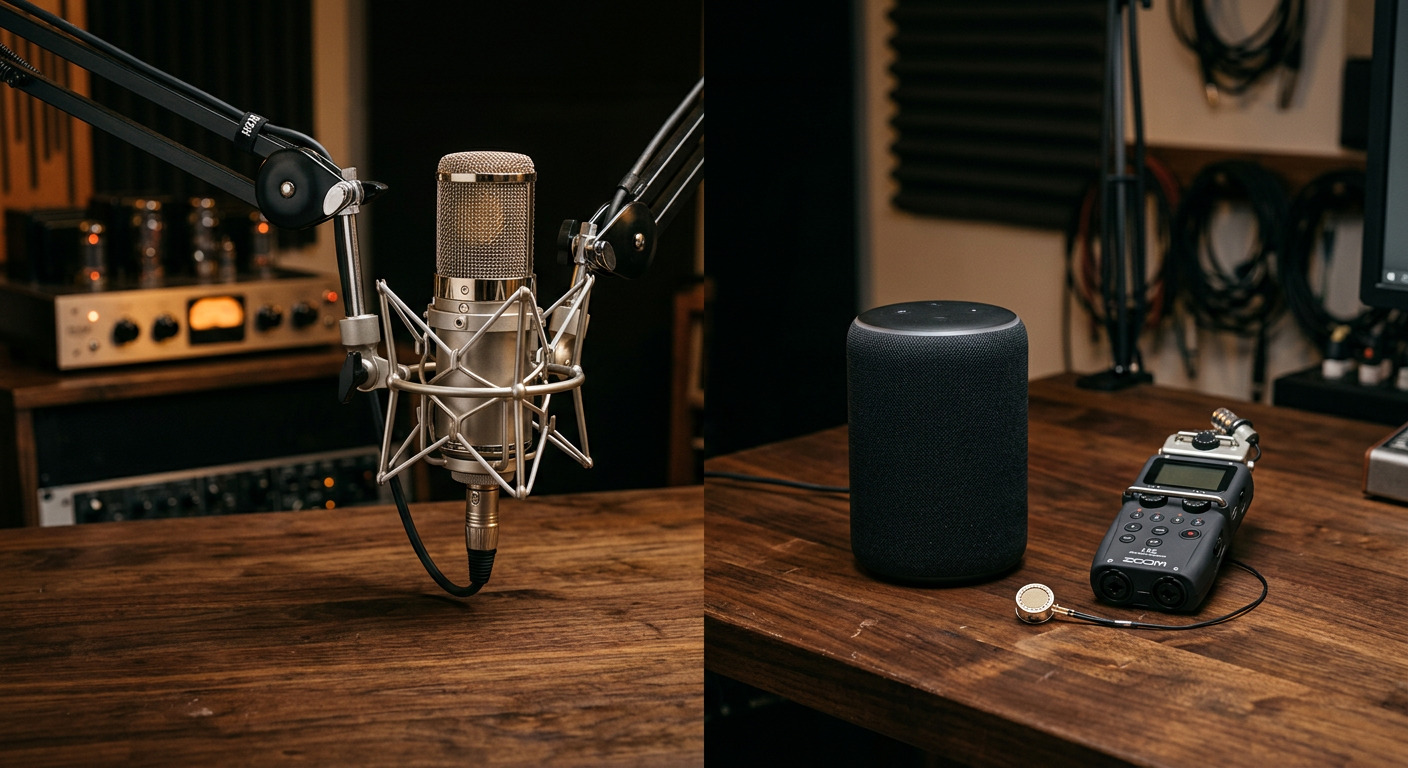
Work through four questions in order. Does the product run on a battery or a small DC rail? If yes, the electret is effectively decided. Is the acoustic environment humid, outdoor or washdown-exposed? If yes, the same conclusion holds for durability reasons. Does the product need more than about 15 dBA of margin against its own noise floor for critical listening? If yes, a true condenser belongs in the design. Is the capsule going onto a PCB? If yes, only the electret applies.
In most embedded projects the answer is therefore an electret capsule, and the real engineering work moves to bias network design, acoustic porting and sealing. TAT supplies ECM capsules across these formats and can quote sensitivity and directivity options against a specific application; the catalogue entry point is the electret microphone range.
The electret condenser microphone and the true condenser differ at the level of physics, not marketing: one stores its own charge, the other is polarized continuously from outside. Everything else — capsule size, power budget, humidity tolerance, cost and manufacturing method — follows from that single distinction.
For product design, this makes the decision fairly mechanical. Battery-powered, space-constrained, high-volume devices use electret capsules; controlled-room recording uses true condensers. Where the choice is genuinely close, as in podcasting or voiceover, the deciding factors are self-noise and the quality of the surrounding preamp rather than the capsule architecture alone.
Before you commit a design, confirm four things in writing with your supplier: the sensitivity and its test conditions, the output impedance, the directivity and its mechanical porting, and the RoHS documentation for the exact part number you are buying. These are the four values most often left vague in catalogue copy, and the four that decide whether the finished product sounds right.
A: A true condenser needs a continuous external polarization voltage, normally 48 V phantom power, applied across the capsule before it produces any output. An electret condenser microphone stores its charge permanently in the electret material, so it needs only a small bias — roughly 1–10 V — to operate the internal JFET impedance converter. The practical consequence is that a true condenser cannot run from a battery, while an ECM draws only microamps and can.
A: For voiceover, podcasting and most spoken-word work, yes — modern electret capsules reach 20 Hz–20 kHz with sensitivity in the −42 to −25 dB range, which is competitive with entry-level studio microphones. For critical music capture, particularly quiet acoustic sources in a treated room, true condensers remain preferable because their self-noise floor is lower and their lighter diaphragms track transients more accurately. The capsule is only part of the chain in either case; the preamp and the room usually matter more.
A: The true condenser is the more fragile of the two. Its polarization field sits across a very small gap, so humidity and condensation can bridge it and cause crackle, sputtering or permanent change. An ECM has no high-voltage gap to bridge, tolerates humidity far better, and can be built into sealed or waterproof housings. Suppliers commonly quote operating lives in the 30,000 to 50,000 hour range for electret capsules, although this is a durability statement rather than an acoustic one.
A: Choose a unidirectional or noise-cancelling capsule when you need to isolate a speaker close to the microphone, as in automotive hands-free kits, headsets and TWS earbuds; the rear acoustic port rejects sound arriving from behind the capsule. Choose an omnidirectional capsule when you want even pickup from all directions, as in room monitoring, conference units and general environmental sensing. The pattern is fixed at manufacture, so it has to be decided with the mechanical layout, not after it.
A: Four things, in this order. Match the preamp input impedance well above the capsule's roughly 2.2 kΩ output impedance. Size the bias resistor so that the resulting high-pass corner sits below your band of interest. Plan the acoustic port and its sealing together with the enclosure, because the port is part of the acoustic design. And keep switching supplies and digital traces away from the capsule and its bias node, adding RC filtering on the bias line where layout makes that unavoidable. Confirm the sensitivity, directivity and RoHS documentation for the exact part number before release.
Ready to specify an electret capsule for your next product? TAT Electronics supplies electret condenser microphones in multiple footprints and directivities, with datasheets and RoHS documentation available per part number. Send your target sensitivity, directivity and enclosure constraints through our contact page and we will come back with the closest matching capsule and a sample plan.


