
English 
Dedicated to global electroacoustic technology.
Views: 0 Author: Site Editor Publish Time: 2026-10-16 Origin: Site


If you are sourcing speakers for a commercial public address system, the practical answer is: design for intelligibility, not volume — a system can be loud and still be impossible to understand. Intelligibility is measurable, and the standard that defines it (IEC 60268-16, the Speech Transmission Index) is the right place to start. This guide covers what each type of PA load really needs, how to match a multi-speaker line, and how to choose between a higher-cost and a lower-cost path.
SPL vs. Intelligibility: Raw decibels don't guarantee that a voice message is clear. Public address drivers must prioritize mid-range clarity (typically 500Hz to 4kHz) to push through environmental noise without distorting.
Load Stratification: A paging chime, a continuous background music channel, and an emergency alarm impose vastly different mechanical stresses on a speaker component. You must specify the driver based on its primary load.
Multi-Speaker Line Matching: Commercial systems utilize constant-voltage lines (70V or 100V) and step-down transformers to chain dozens of speakers across large distances. Impedance calculations here are entirely different from consumer audio.
24/7 Reliability Check: PA components must survive continuous duty cycles. Engineering for long-duty reliability involves selecting resilient adhesives, synthetic membranes, and robust voice coils.
Design for the Furthest Listener: Free-field distance loss means the SPL you need at 1 m is set by the furthest seat, not by the amplifier's rating. A listener 8 m out who needs about 70 dB implies roughly 88 dB at 1 m.
Count Wattage Taps, Not Ohms: On a constant-voltage line the amplifier sees transformer taps, not driver impedance. Keep total tapped wattage about 20% below the amplifier's rated output.
In commercial audio, success is not defined by how loud the speaker gets, but by how well the listener understands the message. The industry uses the Speech Transmission Index (STI) — standardized under IEC 60268-16 — as a numeric representation of this clarity. It ranges from 0.0 (completely unintelligible) to 1.0 (perfectly clear). For emergency evacuation systems, local fire codes typically mandate a minimum STI (often around 0.50).
Achieving a high STI rating starts with the transducer. The driver must have a tight, controlled frequency response tailored specifically to the human voice spectrum.
If a facility manager simply cranks up the amplifier volume, a low-quality speaker driver will reach its excursion limit and begin to distort. This distortion introduces unwanted harmonics that smear the consonants in human speech. Furthermore, in an acoustically live environment (like a concrete train station or an empty gymnasium), pushing excessive volume excites the room's natural reverberation, creating a massive echo chamber that destroys intelligibility.
The goal is to deliver clean, undistorted sound at a moderate Sound Pressure Level (SPL) directly to the listener's ears, which requires highly efficient, well-damped drivers rather than brute-force wattage.
The level you actually need follows from geometry. A listener 8 m from the source who needs about 70 dB at the ear implies roughly 70 + 20 × log10(8) ≈ 88 dB at 1 m, before room absorption is counted. That single figure — not the amplifier's wattage — is what you hand a supplier as an SPL target, and it is also why a distributed layout so often outperforms one large horn.
Illustrative method only; not a TAT product specification.
A commercial PA system handles three distinct types of audio loads, each demanding specific component attributes.
Background Music & Routine Paging: This load requires moderate power handling and a reasonable low-frequency extension. The components need to be pleasant to listen to for hours on end, without causing listener fatigue.
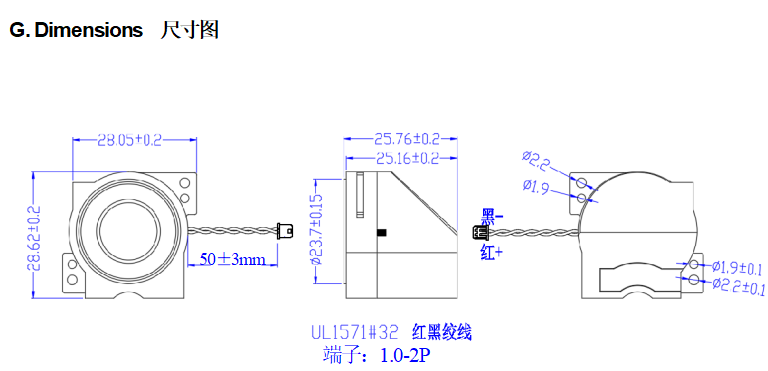
Emergency Alarms: Alarm signals are typically single-frequency tones or harsh sirens. These place extreme thermal stress on the voice coil but do not require wide frequency response. A component like the TATSP26A-001 alarm speaker, which we publish with a rating of 0.8W at 8Ω and a massive SPL of 99±3dB @0.8W/10cm, is engineered specifically to punch through ambient noise with maximum efficiency.
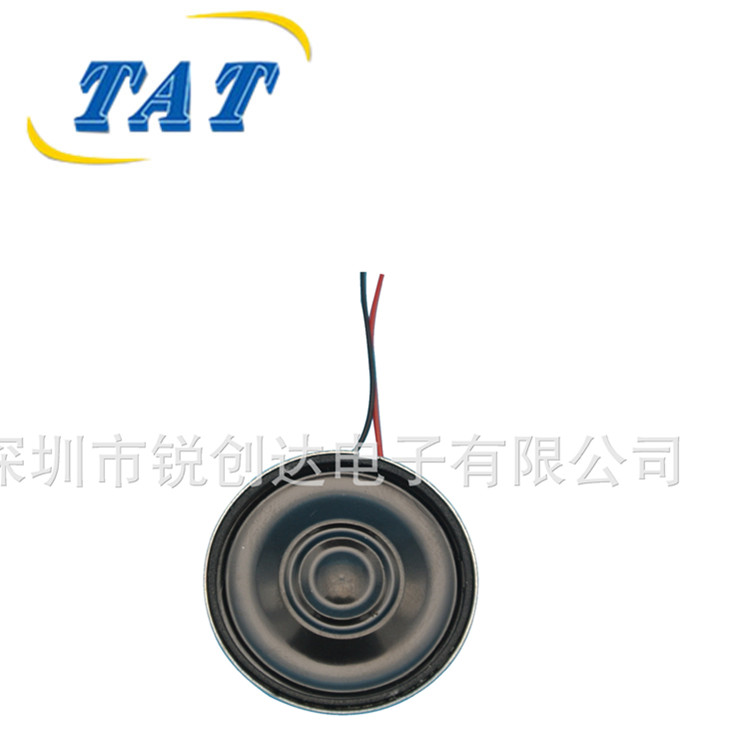
Smart Voice Interaction (Two-Way Voice): Modern smart speaker systems (such as intercoms or access control panels) require both clear playback and acoustic stability so they do not interfere with the nearby microphone. The TATSP23A-001 professional PA loudspeaker component, rated for 0.5W continuous (0.7W maximum) at 8Ω with a 750Hz Fo, provides the necessary mid-range articulation for two-way dialogue without rattling the enclosure.
If you are wiring a single smart speaker in an elevator lobby, standard 8Ω impedance rules apply. However, if you are wiring an airport terminal with 50 speakers on a single amplifier channel, wiring them all in series or parallel using standard 8Ω drivers would either drop the total impedance so low it shorts the amplifier, or raise it so high that no sound is produced.
To solve this, commercial systems use a constant-voltage line (70V in North America, 100V in Europe/Asia). The amplifier outputs a high voltage, allowing the use of thin, cost-effective wire over thousands of feet. At each speaker location, a small step-down transformer drops the voltage and matches the impedance to the 8Ω driver component.
In a 70V/100V system, the impedance of the bare speaker component (e.g., 8Ω) is largely irrelevant to the main amplifier; the amplifier only "sees" the impedance of the primary side of the step-down transformers.
To add a speaker to the line, you simply calculate the power tap on the transformer (e.g., tapping it at 1W, 2W, or 5W). As long as the sum of all the wattage taps on the line does not exceed the total wattage rating of the central amplifier (typically leaving a 20% safety margin), you can continue adding speakers. This makes constant-voltage systems scalable almost without limit: a 60 W amplifier on a 100 V line will carry roughly 60 speakers tapped at 1 W, or about 30 tapped at 2 W, before the safety margin is used up.
Line-load arithmetic is method illustration; confirm against the amplifier's rated tap wattage.
In life-safety and emergency evacuation systems, failure is not an option. The higher-cost path involves specifying drivers with oversized neodymium magnets, high-temperature Kapton voice coil formers, and completely weather-sealed cones. These components are subjected to aggressive environmental stress testing and are often certified by third-party laboratories to meet rigorous local fire codes.
For non-critical environments (like a retail store background music system or a standard waiting room intercom), standard commercial-grade drivers are perfectly adequate. You save costs by utilizing ferrite magnets and treated paper or Mylar diaphragms. The trade-off is that these lower-cost components may have a slightly lower overall SPL and are not rated to survive direct water ingress or extreme temperature fluctuations.
Table 1: Commercial PA System Load Comparison Industry typical parameters; not mapping to specific TAT catalog items.
Load Type | Typical SPL Requirement | Frequency Focus | Primary Engineering Stress |
|---|---|---|---|
Background Music | Low to Moderate (70–80dB) | Full range (100Hz – 15kHz) | Suspension fatigue over long hours |
Paging & Voice | Moderate to High (80–90dB) | Mid-range (500Hz – 4kHz) | Voice coil heat from continuous speech |
Emergency Alarm | Very High (90dB+) | Narrow band (1kHz – 3kHz) | Extreme thermal shock and vibration |
Table 2: Two Paths to the Same Requirement Industry typical parameters; not mapping to specific TAT catalog items.
Dimension | Higher-cost path | Lower-cost path |
|---|---|---|
Speakers | Oversized neodymium magnets, high-temperature Kapton formers, fully weather-sealed cones | Ferrite magnets, treated paper or Mylar diaphragms |
Amplifier / line | Larger amplifier with deliberate headroom, supervised and monitored line | Standard amplifier on a tapped line, no supervision |
Coverage | Engineered distributed layout with a verified STI result | Even ceiling spacing, verified by listening |
Verification | Third-party laboratory testing against local fire codes | Manufacturer data sheet plus incoming inspection |
Net result | Code-compliant life-safety performance at higher unit cost | Adequate for background music and routine paging at lower unit cost |
If a venue suffers from poor speech intelligibility due to high reverberation, simply installing a higher-wattage amplifier and a louder speaker component will make the problem worse.
The engineering solution is distributed audio. Instead of placing two massive 50W horns at the front of a warehouse, install twenty 1W micro speakers distributed evenly across the ceiling. By keeping the SPL of each individual speaker component for public address relatively low, you prevent the room's reverberant field from overpowering the direct sound. The listener is never too far from a speaker, resulting in crystal clear intelligibility with a fraction of the total acoustic energy.
PA systems run continuously. Before components completely fail, they degrade. Maintenance crews and installation technicians should perform periodic checks to ensure the system maintains its required STI rating:
Transformer saturation: Ensure the step-down transformers are not overheating due to excessive bass frequencies.
Cone degradation: Inspect treated paper cones in humid environments for sagging or mold, which alters the resonant frequency (Fo).
Terminal corrosion: Check the solder joints and wire harnesses for oxidation, which increases resistance and drops the line voltage.

Specification sheets in this category vary between revisions and grades. The three values you must have in writing before tooling — impedance, rated input power, and maximum power — are frequently the three that marketing copy simplifies. Ask for the controlled specification sheet for the exact grade you are buying, not the catalogue line.
Whether your next project is a distributed smart speaker network, a standalone emergency system, or requires buzzer alarms for signalling, TAT Electronics offers a proven portfolio. Our engineers supply rigorous data for professional PA loudspeakers (TATSP23A-001) and high-efficiency alarm speakers (TATSP26A-001), supporting integrations across various public safety and intelligent control applications.
Commercial public address design starts with the furthest listener, not the closest one. A listener 8 m from the source who needs about 70 dB at the ear implies roughly 88 dB at 1 m, and that single number already tells you which drivers are candidates for the job. Work outward from it: select the driver class for the load, then decide whether a constant-voltage line or a low-impedance system is the more economical route.
The line decision is an arithmetic decision. A 60 W amplifier on a 100 V line will carry roughly 60 speakers tapped at 1 W, or about 30 tapped at 2 W. Once the line is fixed, count wattage taps rather than ohms, and keep the total tap load safely below the amplifier’s rated output.
Before handover, verify intelligibility in the installed space rather than on the bench, confirm the tap wattage against the amplifier’s rated output, and document the driver ratings for the exact grades used.
A: The required SPL depends entirely on the ambient noise of the environment. A general rule of thumb is that the PA system must produce an SPL at least 10dB to 15dB higher than the ambient noise level at the listener's ear to ensure clear intelligibility.
A: In a 70V or 100V constant-voltage system, you do not calculate complex series/parallel driver impedances. You simply add up the wattage tap settings on all the speaker transformers. As long as the total tapped wattage is roughly 20% less than the amplifier's maximum rated output, the system is safely matched.
A: Routine visual and audible inspections should occur annually. However, life-safety and emergency evacuation speakers must be electronically tested (often using automated line-monitoring equipment) according to local fire and safety codes, which may dictate monthly or quarterly verifications.
A: A traditional bluetooth speaker simply acts as a wireless receiver for audio playback. A smart speaker integrates an active network connection (Wi-Fi), a microphone array, and onboard processing to interact with voice assistants and home automation protocols, requiring far more rigorous acoustic isolation to prevent the speaker from interfering with the microphone.
A: Prioritize a distributed layout. Rather than using a few loud speakers, space many lower-power speakers evenly across the ceiling or walls. Tap the transformers to a lower wattage to minimize room reverberation, ensuring that every listener receives direct, clear sound rather than reflected echoes.


