
English 
Dedicated to global electroacoustic technology.
Views: 0 Author: Site Editor Publish Time: 2026-11-13 Origin: Site


Since the global electronics industry transitioned toward high-density surface-mount technology (SMT), designing compact printed circuit boards has required components that support fully automated assembly. Today, as devices shrink and production speeds accelerate, manual soldering of audio indicators has become a costly bottleneck. This shift toward surface-mounted devices (SMDs) is significantly reshaping modern electronic system design, driving the need for automated assembly-friendly parts.
To address both mechanical handling and electrical performance challenges, the TAT BM5020S serves as a specialized SMD electromagnetic buzzer engineered specifically for high-speed SMT lines. By combining a robust liquid crystal polymer (LCP) housing with a highly stable internal diaphragm, this component delivers reliable acoustic signaling without compromising assembly efficiency. It directly solves the problem of integrating durable, low-power audio alerts into space-constrained board layouts.
In this article, you will learn how the BM5020S optimizes automated pick-and-place workflows and survives lead-free reflow temperatures. You will also discover how its low power consumption and long operational lifespan can enhance your next hardware design.
Modern printed circuit board assembly (PCBA) demands high precision and speed. By adopting an SMD electromagnetic buzzer, you can utilize fully automated assembly processes. This transition ensures consistent acoustic performance across dense printed circuit boards while eliminating manual soldering variability.
The 5020 size series offers a highly compact surface-mount design. This miniature profile is ideal for space-constrained applications where manual soldering is physically impractical. Integrating automated-friendly audio components reduces manufacturing cycle times and minimizes human error during the assembly of modern circuit developments.
Assembly Method | Component Type | Board Density Support | Process Efficiency |
|---|---|---|---|
Manual Soldering | Through-Hole | Low (Requires clearance) | High human error risk |
Automated SMT | SMD (e.g., 5020) | High (Dense layouts) | Low error, fast cycle times |
The the part stands out by combining mechanical compatibility for SMT lines with robust electrical and acoustic performance. When you are designing modern printed circuit boards, finding an audio component that can withstand the fast pace of automated assembly while delivering consistent sound is a major challenge. The BM5020S resolves this conflict by matching precise physical dimensions with high-grade industrial materials.
The following table summarizes the key technical specifications and material properties that make this component highly effective for modern surface-mount applications:
Parameter / Feature | Technical Specification | Design Benefit |
|---|---|---|
Housing Material | Liquid Crystal Polymer (LCP) | Survives high-temperature lead-free reflow |
Terminal Material | Tin-plated brass | Maintains stable coplanarity and strong solder joints |
Operating Voltage | 1.5 V to 5 V | Ideal for low-power and battery-operated circuits |
Current Consumption | 10 mA to 30 mA | Minimizes system power draw |
Sound Pressure Level | 85 dB to 95 dB at 10 cm | Delivers clear, highly audible alerts |
Frequency Range | 2 kHz to 4 kHz (±2% stability) | Ensures highly consistent acoustic output |
Operational Lifespan | Greater than 50,000 hours | Reduces maintenance and replacement costs |
To keep assembly lines running at peak efficiency, every component on a printed circuit board must be optimized for robotic handling. The BM5020S features a black molded block body with precisely aligned terminals, specifically sized to fit standard SMT pick-and-place nozzles. This flat, smooth top surface allows the vacuum nozzle of an automated placement machine to achieve a secure grip every time, preventing parts from dropping or shifting during high-speed transport across the factory floor.
Additionally, its tape-and-reel packaging ensures seamless feeding into automated assembly lines, reducing component misplacement and production downtime. When components are packaged in standardized reels, they feed smoothly into SMT feeder systems without jamming. This packaging method protects the delicate terminals from bending before they reach the board, ensuring that each unit aligns perfectly with its designated solder pads during high-volume production runs.
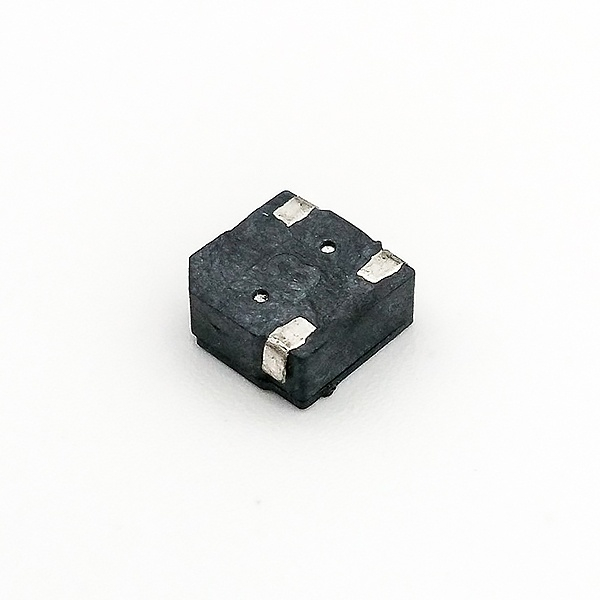
Lead-free reflow soldering requires circuit boards to pass through convection ovens with intense thermal profiles, pushing peak temperatures well above the melting point of ordinary consumer plastics. Standard plastics can easily melt, warp, or blister under these conditions, ruining the acoustic performance of internal parts. Constructed with a liquid crystal polymer (LCP) housing and tin-plated brass terminals, the buzzer survives the high thermal profiles of lead-free reflow soldering.
The robust material selection prevents housing deformation or terminal misalignment during intense convection oven passes. Liquid crystal polymer is a high-performance plastic known for its exceptional heat resistance and dimensional stability. By utilizing LCP, the BM5020S maintains its structural integrity throughout the entire soldering cycle. At the same time, the tin-plated brass terminals provide excellent solderability, ensuring strong, reliable solder joints without the risk of shifting out of alignment.
A buzzer must do more than just survive the assembly process; it must also deliver clear, reliable audio signals over its entire operating life. Utilizing an electromagnetic coil and diaphragm structure, the buzzer reliably delivers a sound pressure level of 85 to 95 dB at 10 cm, and the figure should be read the way any sound level measurement is read — meters are verified against IEC 61672-1, so confirm test distance and drive conditions before comparing parts. When an electrical current passes through the internal coil, it generates a magnetic field that moves the diaphragm rapidly, producing a crisp, highly audible alert that can easily cut through ambient background noise.
This SMD electromagnetic buzzer operates within a 2 kHz to 4 kHz range with a tight plus or minus 2 percent frequency stability, and supports custom frequency selection on request. This high level of stability means your device will maintain a consistent tone, even when environmental conditions change. If your specific application requires a unique tone to differentiate alerts, you can request custom frequency settings within the supported range, and TAT can supply recommended driving circuit diagrams and frequency response curves to simplify your development process.
For modern portable electronics, managing the system power budget is a constant challenge. The buzzer operates efficiently within a rated voltage range of 1.5 V to 5 V while drawing a minimal current of 10 to 30 mA. This highly efficient power profile allows you to design clear audible alerts into your system without putting a heavy drain on the battery or power supply.
This low power profile makes it highly suitable for handheld devices, wearables, medical monitors, and smart home equipment. Whether you are building a compact fitness tracker or a portable medical monitor, minimizing current draw is essential (and if the product carries an alarm function, the acoustic alarm requirements sit outside the buzzer datasheet — the alarm-systems part of IEC 60601-1-8 is the usual reference, current edition to be confirmed) for extending battery runtimes. The BM5020S provides the necessary acoustic output while remaining highly conservative with its energy consumption, making it an excellent fit for compact, battery-operated devices.
When deploying products in industrial or security settings, maintenance can be difficult and expensive. Engineered for long-term reliability, the BM5020S provides an operational lifespan of more than 50,000 hours. This extended durability is the result of rigorous environmental testing, which ensures the internal coil and diaphragm resist wear and tear over years of continuous use.
This extended durability makes it an ideal fit for critical alarm systems, security devices, and industrial controls where maintenance access is limited. If a component fails in a sealed security system or an industrial control panel, repairing it requires significant downtime. By selecting a reliable surface-mount buzzer with a proven lifespan, you can ensure your systems remain active and vocal when they are needed most, reducing long-term service costs and building customer trust.

During surface-mount technology (SMT) assembly, maintaining coplanarity between your PCB substrate and the SMD package is critical for uniform solder joint formation. Coplanarity measures the maximum distance between the lowest and highest contact points of the component terminals when resting on a flat surface.
If either your printed circuit board or the buzzer package warps during reflow, this insufficient coplanarity can cause open solder joints or electrical shorts. The pre-aligned tin-plated brass terminals of the this SMD buzzer SMD electromagnetic buzzer help maintain stable coplanarity, which you can further optimize with precise stencil design and paste monitoring.
You can optimize this process on your SMT line by following these steps:
Design precise stencils: Match aperture sizes to terminal dimensions to ensure even solder volume.
Monitor paste deposition: Use solder paste inspection to verify height and volume before component placement.
Control reflow temperatures: Manage thermal ramping to prevent board and component warpage.
Ensuring clean spaces under the compact SMD footprint of the the part is essential to prevent dendritic growth and potential electrical leakage over time. When flux residues remain trapped beneath the low-profile housing, ambient moisture can react with these contaminants. This reaction creates microscopic metallic pathways that lead to short circuits and board failure.
To address this risk, you can use transparent glass test boards carrying dummy parts of the same footprint to develop, monitor, and refine your PCBA cleaning process. This methodology allows you to visually inspect how well cleaning agents penetrate beneath the component. You can optimize your cleaning cycle through the following steps:
Substitute with glass: Mount dummy components on transparent glass substrates to observe fluid flow.
Monitor residue removal: Check if the cleaning agent successfully dissolves and flushes out flux from under the footprint.
Refine parameters: Adjust wash nozzle pressure, temperature, and cycle duration based on visual feedback.
Once you complete the cleaning process, you must verify that the component still performs to its acoustic specifications. You can request recommended driving circuit diagrams and frequency response curves directly from TAT to assist with this evaluation. Comparing your post-wash acoustic output against these reference curves ensures that no trapped fluid or physical damage has compromised the sound pressure level or frequency stability of your SMD electromagnetic buzzer.
The this SMD buzzer successfully bridges the gap between high-speed automated PCBA assembly and reliable, long-lasting acoustic signaling. By addressing critical manufacturing factors like coplanarity, reflow survival, and post-assembly cleaning, this SMD electromagnetic buzzer minimizes defects on your production line. Leveraging its low power draw, custom frequency options, and durable LCP housing allows you to optimize modern electronic designs efficiently. If your board needs a slightly taller body or a different acoustic profile, the BM5030S SMD electromagnetic buzzer shares the same surface-mount approach and is worth comparing before you freeze the footprint. To begin integration, review your board's thermal profile and contact TAT to obtain the recommended footprints and driving circuits for your next prototyping phase.
The this SMD buzzer operates efficiently within a rated voltage range of 1.5 V to 5 V while drawing a low current of 10 to 30 mA. This minimal power consumption makes it highly suitable for battery-operated devices and compact systems where energy conservation is critical. You can integrate this component into your design without worrying about excessive battery drain.
The buzzer features a high-temperature Liquid Crystal Polymer (LCP) housing that withstands the extreme thermal profiles of lead-free reflow soldering. This industrial-grade material prevents physical deformation and keeps the tin-plated brass terminals perfectly aligned during intense convection oven passes. Consequently, you can run your automated SMT lines at standard temperatures without risking structural damage to the component.
Yes, TAT supports custom frequency selection within the 2 kHz to 4 kHz band to match your specific signaling needs. While the standard model delivers a highly stable output with a tight plus or minus 2 percent operating frequency tolerance, you can request tailored configurations. You simply need to contact the supplier to obtain the appropriate driving circuit diagrams and frequency response curves.
You can expect an operational lifespan exceeding 50,000 hours under normal operating conditions due to its robust internal coil and diaphragm architecture. This extended durability is verified through rigorous reliability testing, including thermal shock cycles and constant humidity chamber exposure. This makes the component an ideal choice for long-term installations like security alarms and industrial control systems.
You can effectively develop and monitor your cleaning process by utilizing transparent glass test boards to visually inspect for trapped flux residues. Ensuring a clean space beneath the compact footprint is vital to prevent dendritic growth and electrical leakage over time. After refining your wash parameters, you can verify the post-assembly acoustic performance by comparing your results against TAT’s reference curves.


