
English 
Dedicated to global electroacoustic technology.
Views: 0 Author: Site Editor Publish Time: 2026-11-14 Origin: Site


A silent buzzer on a freshly assembled board is one of the most expensive defects in small electronics, not because the part costs much, but because the diagnosis happens after the board is populated. The instinct is to blame the component. Most of the time the component is fine, and the failure sits in one of six places that can be checked in a fixed order before anything is touched with a hot air tool.
This article is a diagnostic sequence for surface-mount piezoelectric buzzers, using the BP1230S as the reference part and a pin-mount piezo element as a control sample. The order matters: the cheapest and most reversible checks come first, and the destructive ones last.
Before measuring anything, classify the symptom. There are only four useful categories, and each points at a different part of the chain.
No sound at all suggests the drive signal never arrives, or the element is mechanically dead. Weak or distorted sound suggests the element moves but the acoustic path is compromised. Intermittent sound that responds to board flex suggests a joint or a cracked element. Sound that appears only at certain drive settings suggests the firmware is asking the part to do something outside its intended operating point.
A buzzer that never sounds and a buzzer that sounds wrong are different problems, and treating them as one wastes the most valuable diagnostic step: the first measurement.
The first check is the joint, and it is visual before it is electrical. A surface-mount piezo buzzer is a ceramic element in a plastic housing, and the housing is made to survive reflow, not to be immune to it. The BP1230S housing is stated as LCP and PPS, which is the material choice that lets a part go through a lead-free reflow profile without deforming. If the housing has visibly softened, flowed, or changed colour, the profile was wrong and the part should be treated as suspect regardless of what the meter says.
The solderability and soldering-heat requirements for surface-mount devices are described in IEC 60068-2-58, which is a reasonable orientation for what a reflow-compatible part is expected to survive. Check the current edition before writing a profile around it.
Look at both terminations. A joint that looks dull and grainy, or that has pulled away into a fillet with a visible gap, will pass a continuity test at room temperature and fail after a thermal cycle. This is the classic intermittent case: the buzzer works on the bench supply and goes silent in the enclosure after the product warms up.
A piezoelectric buzzer makes sound by moving a diaphragm, and the sound leaves through a port. If that port is covered, the part is working perfectly and the product is silent.
Three things cover ports in production. Conformal coating is the most common, because a spray that protects the board also seals the opening. Ultrasonic cleaning can drive residue into the port and leave it there. And a gasket, tape or label applied during assembly can sit directly over the opening.
The test is simple: compare the sound with the port open and with the housing removed. If the level jumps when the obstruction is cleared, the part was never the problem. On a part with a stated sound pressure level of at least 85 dB at 10 cm, a blocked port can easily cost more than the entire margin between pass and fail.
A passive piezoelectric buzzer has no oscillator. It produces the tone you feed it, which means the firmware, the driver stage and the waveform are all part of the acoustic design.
Check the waveform at the buzzer terminals with a scope, not with a multimeter. A multimeter reports an average, and a piezo element responds to the peak-to-peak swing and to the edge rate. Two drive circuits that both read the same average voltage can differ by many decibels at the diaphragm.
Take the pin-mount BP9019S-40 as a control. Its oscillation frequency is 4000 Hz, its operating voltage is 1 to 25 Vp-p with a rated voltage of 3 Vp-p, and its sound pressure level is a minimum of 65 dB at 10 cm measured at that rated voltage with a square wave. Every qualifier in that sentence is a diagnostic handle. Drive it at 3 Vp-p with a square wave and you should get the specified output. Drive it with a sine wave at half the amplitude and you will measure something much lower without the part being defective.
Then check the duty cycle and the DC offset. A drive that sits on an offset biases the element and reduces the usable swing. A drive with a very short pulse delivers far less energy than a square wave at the same amplitude.
Piezoelectric elements are ceramic, and ceramic is brittle. A part that was fine at incoming inspection can be cracked after a reflow cycle or after a rework attempt with a hot air tool held too close.
The BP9019S-40 is rated for operation from -30 to +70 degrees Celsius, with a storage range of -40 to +85 degrees Celsius. Those are the conditions the part is designed to live in, and they are not the conditions it sees during assembly. If a buzzer fails only after a rework, the rework is the suspect.
The practical check is to compare a failed unit with an untouched unit from the same reel. If the untouched unit sounds correct and the reworked one does not, stop looking at the schematic.
Flux residue and cleaning chemistry attack the element and the housing in ways that are invisible under a normal inspection microscope. Residue across the terminals creates a leakage path that loads the drive, and residue inside the housing damps the diaphragm.
This failure mode is slow. A contaminated part often passes at first and degrades over hours or days of operation, which is why field returns from this cause look random. If failures cluster in one production lot rather than one design, contamination or a process change is the more likely explanation than a design error.
The last check is the least comfortable, because it means the specification was wrong rather than the process.
A passive piezo element and an active buzzer with a built-in oscillator are not interchangeable. Feed a DC voltage to a passive element and it clicks once and stops. Feed the same DC to an active part and it sounds continuously. A board designed for one and populated with the other will fail in exactly the way that looks like a dead component.
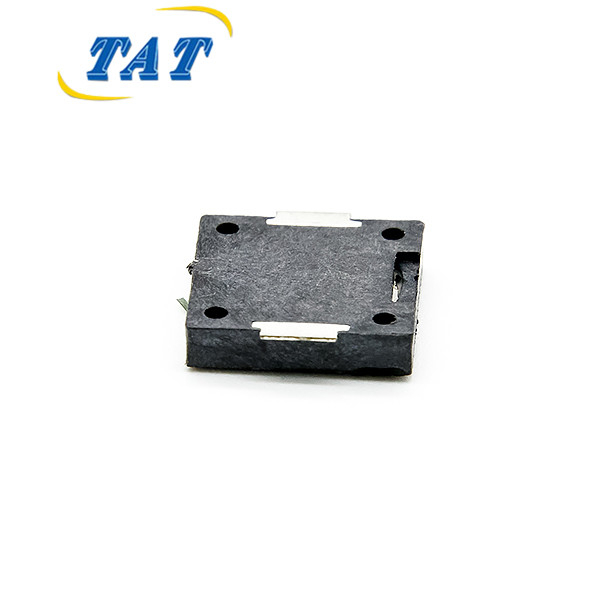
The BP1230S is a passive surface-mount piezo element, offered in compact footprints including 7 mm, 9 mm and 12 mm, with a current draw stated as typically below 10 mA and a sound pressure level quoted between 85 dB and 100 dB at 10 cm depending on drive conditions. That quoted range is a warning as much as a specification: the part's output is a function of how it is driven, so a design that assumes a fixed number will be disappointed at one end of the range.
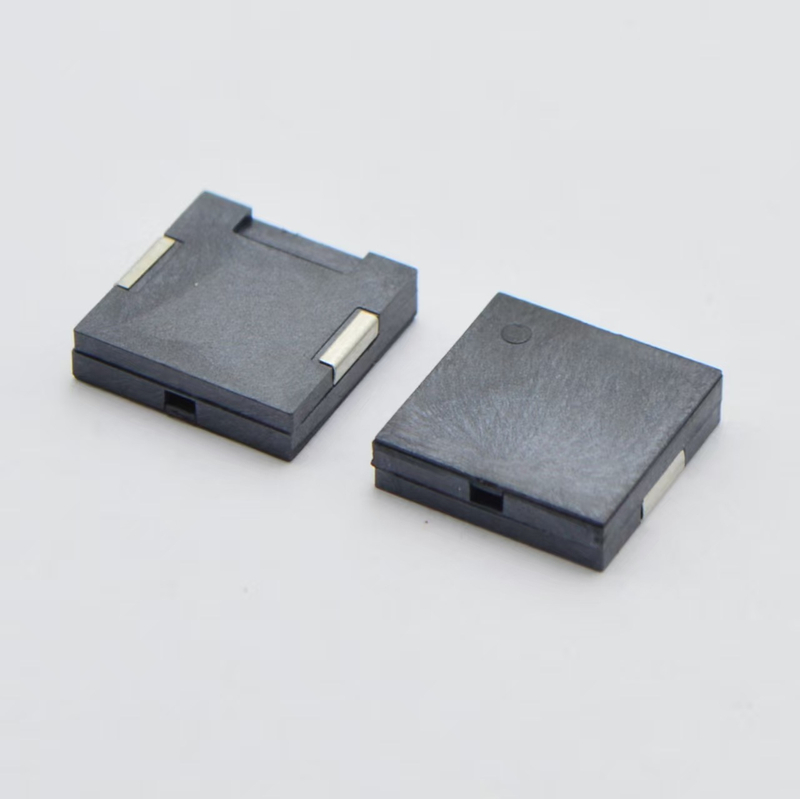
A specification table is usually read once, at selection time. It is more useful during a failure investigation, because every line tells you what to measure and under what conditions.
Sound pressure level is the clearest example. A figure quoted at 10 cm on the axis of the port cannot be compared with a measurement taken at 1 m without correction, and a figure quoted at a rated voltage cannot be compared with a measurement taken at a different drive. When a supplier and a customer disagree about a quiet buzzer, they are usually measuring under different conditions rather than looking at different hardware.
The measurement instrument matters too. Sound level meters are classified and verified against IEC 61672-1, which defines how the meter weights and averages what it hears. An A-weighted reading and a linear reading of the same buzzer will not agree, and neither is wrong. Record the weighting, the distance, the drive voltage and the waveform alongside every number you write down, or the comparison you make next week will be meaningless.
The operating temperature range is the second diagnostic line. A part rated from -30 to +70 degrees Celsius that fails in a product running warmer than that is not a defective part. Check the actual temperature at the buzzer body under load before you ask for a replacement.
Rework is where good parts become bad ones. Three rules cover most of the risk.
Heat from below where possible. A piezo element is a ceramic disc bonded into a housing, and direct hot air on the housing face transfers heat into the bond line. Preheating the board and using a controlled bottom-side heater is gentler than a top-side nozzle at high temperature.
Do not lever against the housing. The plastic is stiff and the bond is stronger than the housing wall in shear. If the part must come off, cut the joints or use a blade under the terminal, never a probe against the body.
Replace rather than reuse. A buzzer that has been removed has been through two reflow-equivalent heat cycles and a mechanical shock. The cost of the part is small compared with the cost of a second failure in the field, and a reused buzzer that fails intermittently is nearly impossible to diagnose later.
Sometimes the process is correct and the part is still the wrong choice. Three signals point that way.
The first is a design that needs more output than the element can deliver at the available voltage. A piezo element's output scales with drive amplitude, so a low supply rail limits the acoustic result no matter how good the part is. The fix is a different part or a boost stage, not a process change.
The second is a mechanical constraint that closes the acoustic path. If the enclosure leaves no room for a port, no amount of reflow tuning will make the product audible.
The third is a temperature requirement outside the part's rated range. Selecting a part whose operating range covers the real product environment is cheaper than adding thermal management around a part that does not.
Diagnose in order, from the joint outward. Check the solder and the reflow exposure first, then the acoustic port, then the drive waveform, then the heat history, then contamination, and only then question the part family. Each step is cheaper than the one after it, and the first four resolve the large majority of silent-buzzer reports.
When you do reach the specification, read it as a set of conditions rather than a set of promises. The surface-mount buzzer category lists the passive piezo options with their footprints and drive requirements, and the full buzzer range covers the pin-mount alternatives when a surface-mount part cannot meet the acoustic requirement.
Why does my buzzer click once and then go silent?
That is the signature of a passive piezo element driven with DC. A passive part has no oscillator, so a steady voltage produces a single mechanical step and no continuous tone. Supply a square wave at the intended frequency and the part will sound.
Can I test a piezo buzzer with a multimeter?
You can check continuity and look for a short, but a multimeter cannot tell you whether the part will produce sound at the right level. The element responds to peak-to-peak swing and edge rate, neither of which a DC measurement shows. Use a scope and a known drive waveform.
The buzzer is quiet after conformal coating. Is the part defective?
Almost certainly not. Coating over the acoustic port is the most common cause of a sudden level drop after assembly. Clear the port and re-measure before replacing anything.
Does reflow damage piezoelectric buzzers?
A part whose housing is specified for reflow, such as an LCP or PPS body, is designed to survive the profile. Damage usually comes from a profile outside the intended window, or from rework with a hot air tool rather than from the original reflow cycle.
How do I know whether the failure is the part or the board?
Compare against an untouched unit from the same reel, driven by the same circuit. If the untouched unit sounds correct at the same drive, the board is exonerated and the failed unit is the suspect. If both are silent, the drive or the acoustic path is the problem.
What should I record when I measure sound pressure level?
Record the distance, the drive voltage, the waveform and the weighting used by the meter. A figure without those four conditions cannot be compared with a datasheet value or with a measurement taken by a colleague on a different day.


