
English 
Dedicated to global electroacoustic technology.
Views: 0 Author: Site Editor Publish Time: 2026-10-13 Origin: Site


If you are specifying a speaker module for a car audio system, the practical answer is: decide portable versus fixed first, because that one choice fixes your impedance, your power budget, and your enclosure. Heat, vibration, dust, and wiring all follow from it. This guide shows how to make that call, then covers the rear-enclosure and durability details that decide whether the module survives year five.
Purpose Defines Power: Portable, dashboard-mounted, or removable mini box speakers are engineered for voice prompts, navigation instructions, and communication — they are not designed for full-range music playback.
Impedance Dictates Current: Selecting a higher impedance component (like 12Ω or 32Ω) drastically reduces the current load on low-voltage battery amplifiers or factory head units compared to standard 4Ω car speakers.
Thermal and Vibration Stress: The automotive cabin is a hostile environment. Voice coils must survive extreme heat (+85°C under a windshield) and constant mechanical vibration without de-centering.
Acoustic Suspension: A micro speaker in a small sealed box creates an air spring that raises the resonant frequency (Fo). You must engineer the rear enclosure volume carefully to avoid choking the mid-range — a system QTC near 0.707 is the usual starting target.
Series Wiring Is the Safe Multiplier: Two identical 12Ω modules in series present a 24Ω load, which is easy on the amplifier but needs more voltage swing. Two in parallel present 6Ω and ask the amplifier for roughly double the current.
Check the Operating Temperature Window: The published operating range matters as much as the power rating. A driver rated -20°C to +50°C is a different tool from one rated -30°C to +85°C, and a cabin will test both ends of that window.
Traditional car audio components are built for fixed installation in doors or rear decks, using the vehicle's metal structure as an infinite baffle. Modern interiors increasingly add portable or semi-permanent modules instead: add-on navigation units, toll-collection voice prompts, aftermarket hands-free kits, emergency communication boxes.
For those roles a 6-inch woofer is useless. Integrators need self-contained micro modules, typically 15 mm to 40 mm, that deliver penetrating vocals in a noisy cabin without a large external amplifier or any dashboard cutting.
A fixed, flush-mounted speaker draws on the car's 12 V system and a heavy amplifier. A portable or add-on voice module usually runs on its own 3.7 V cell or a trickle from a USB port. That voltage gap flips the rulebook: raw wattage is no longer available for generating volume, so you depend on sensitivity (SPL) and precise impedance matching instead.
Table 1: Portable Module vs. Fixed In-Car Speaker Industry typical parameters; not mapping to specific TAT catalog items.
Dimension | Portable / removable module | Fixed in-dash or door speaker |
|---|---|---|
Mounting | Surface-mounted housing, bracket or clip | Flush-mounted into a cut-out in metal or trim |
Impedance | Commonly 8Ω, 12Ω or 32Ω — chosen to limit current | Commonly 4Ω, chosen to maximise current from 12 V |
Power level | Typically 0.25 W to 1 W continuous | Typically 20 W to 100 W+ per channel |
Enclosure requirement | Own sealed rear volume (a "mini box") must be designed | Uses the door or dash cavity as an infinite baffle |
Serviceability | Removable and replaceable without dismantling the vehicle | Requires trim removal and door-card disassembly |
Best-fit scenario | Add-on navigation units, hands-free kits, toll and prompt modules, emergency call boxes | Factory audio, component upgrades, sound staging |
Standard automotive speakers are generally 4Ω, built to pull maximum current from a 12 V amplifier. For a portable voice module or a secondary prompt speaker on a low-power head unit, though, a 4Ω load can draw more current than the amplifier will tolerate and trip its thermal protection.
Raising the impedance lowers the current demand and makes the part far easier for a small IC amplifier to drive. Our catalogue carries components designed for exactly this constraint. The TATSP32A-001 car audio mini box speaker is specified at 12Ω ±20% with a 0.25 W nominal input and a 0.5 W maximum. For ultra-low-power prompt duty, the TATSP13A-002 micro speaker runs at 32Ω ±20% with a 0.5 W rating. Both keep the amplifier cool through continuous voice playback.
If your design specifies a 12Ω driver to manage current, you must wire it correctly. Applying Ohm's Law (P = V²/R and I = V/R) to the published TATSP32A-001 rating of 12Ω ±20%, a single module at its 0.25 W nominal input sits at roughly V = √(0.25 × 12) ≈ 1.73 V RMS and draws I = V/R ≈ 0.14 A. Push that module to its 0.5 W maximum and the same arithmetic returns V = √(0.5 × 12) ≈ 2.45 V RMS and I ≈ 0.20 A — still a light load for a small IC amplifier, which is precisely why the higher impedance was chosen for this component class.
However, if an installer mistakenly wires two of these 12Ω drivers in parallel, the total load drops to 6Ω. To hold the same voltage across that lower load, the amplifier must deliver roughly twice the current — on the order of 0.40 A where a single module drew 0.20 A. If the amplifier's thermal limit is breached, the audio will distort heavily before shutting down entirely.
Electrical derivation from the published TATSP32A-001 rating; not an SPL or endurance claim.
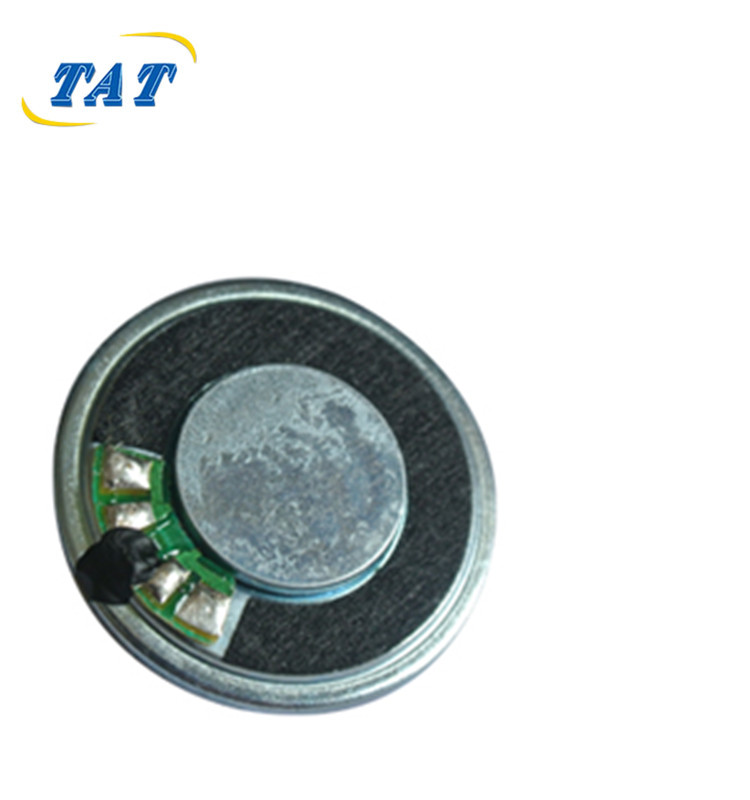
While parked-car ambient air might reach 40°C on a summer day, a black dashboard under direct UV can exceed 80°C at the surface.
A module sitting there needs adhesives that will not melt or off-gas and voice coil formers (Kapton, for instance) that will not warp. Consumer-grade plastics and glues fail quickly in that environment, and once the former warps the coil rubs against the magnet assembly.
Car doors are slammed thousands of times and road vibration never stops. The suspension — surround and spider — has to hold the voice coil precisely centred through all of it. Loose structural tolerances let the coil scrape, producing a harsh scratching distortion that destroys speech intelligibility.
Table 2: Automotive vs. Consumer Environment Stress Industry typical parameters; not mapping to specific TAT catalog items.
Environmental Factor | Typical Consumer Audio | Automotive Cabin (Dashboard/Door) | Component Requirement |
|---|---|---|---|
Operating Temp | +15°C to +35°C | -30°C to +85°C | High-temp voice coil adhesives |
Vibration | Negligible (Static) | Continuous low & high frequency | Ruggedized basket & suspension |
Humidity | 40% - 60% | 10% - 95% (Condensation) | Synthetic Mylar or treated cones |
UV Exposure | None to Low | Extreme (Dashboard mounted) | UV-stabilized enclosures |
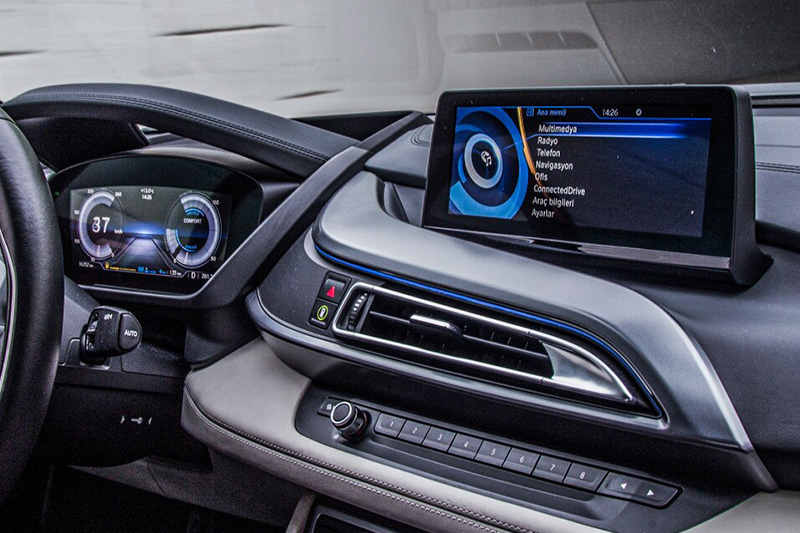
A speaker makes sound by moving air both forward and backward. Let the rear wave wrap around and meet the front wave and the two cancel, most severely at low frequencies. A portable module prevents that by sealing the driver into a small rear enclosure — a "mini box". The cost is that the trapped air behaves as a stiff pneumatic spring pushing back on the cone.
A sealed box adds a pneumatic spring in parallel with the driver's own suspension, so the system resonance rises above the free-air Fo. How far it rises depends on the ratio of trapped air volume to driver compliance, and engineers track the result as system QTC. A QTC near 0.707 is the usual starting target: it yields the most extended, best-damped response a sealed box can achieve on its own, with neither a peak nor a slow roll-off. Shrink the volume and QTC climbs above 1.0, producing a tight, "one-note" bottom end; oversize it and QTC falls toward 0.5, demanding amplifier headroom the module usually does not have.
This trapped air spring dramatically raises the speaker's resonant frequency (Fo). For instance, the TATSP32A-001 component has an Fo of 500Hz ±20% in open air. When placed inside a tight plastic module, that Fo will shift even higher.
Table 3: Sealed Rear Volume vs. Low-Frequency Response General engineering guidance, not TAT enclosure data.
Relative volume | Effect on low-frequency response | Effect on system QTC | Practical note |
|---|---|---|---|
Too small | Sharp roll-off; bass sounds thin and tight | QTC above 1.0 | Common in space-constrained prompt modules; acceptable when speech is the only load. |
Near target | Smoothest usable extension a sealed box offers | QTC ≈ 0.707 | The usual starting point; confirm by measurement, not calculation alone. |
Too large | Extended on paper, but the driver becomes under-damped | QTC below 0.5 | Needs amplifier headroom and excursion capability a micro module rarely has. |
Because frequencies below the Fo drop off sharply, a driver tuned to 500Hz is physically incapable of reproducing deep bass. This is perfectly engineered for its actual purpose: rendering human speech (which primarily occupies the 500Hz to 4kHz band) loudly and clearly in a noisy cabin, rather than attempting to play music.
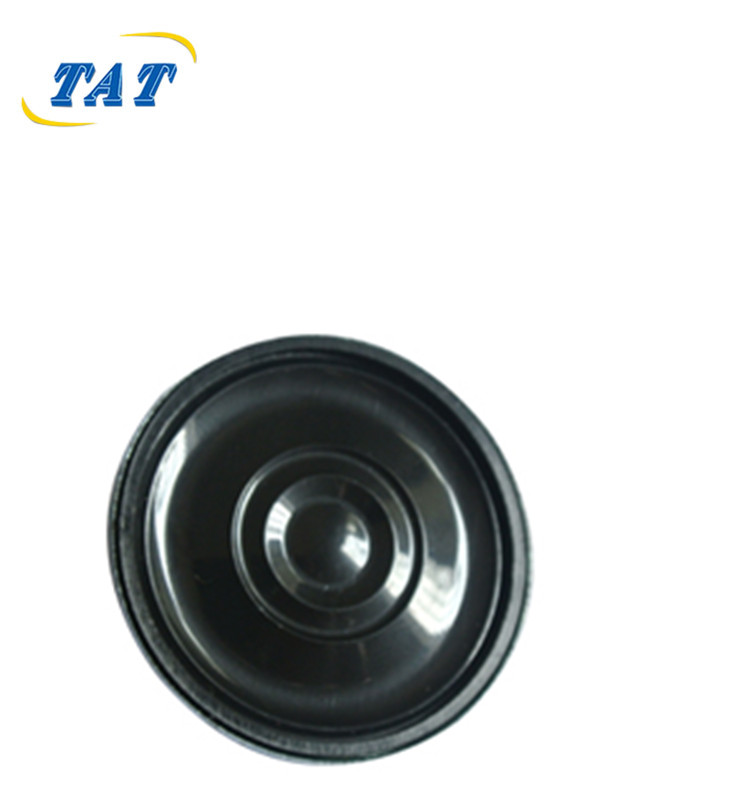
If an aftermarket system requires two identical voice prompt modules to cover both the driver and passenger sides, they must be wired in series if the amplifier cannot handle a low-impedance drop. Wiring two 12Ω modules in series creates a highly safe 24Ω load for the amplifier, ensuring cool operation, though it will require a higher voltage swing to reach the same volume as a single unit.
Beyond heat and vibration, the ingress of fine dust and moisture degrades performance. Condensation forming on the cone over cold nights and evaporating during hot days will eventually destroy untreated paper. Utilizing Mylar speaker components, which inherently resist moisture absorption, is the standard engineering defense to maintain a consistent frequency response over the vehicle's lifespan.
Specification sheets in this category vary between revisions and grades. The three values you must have in writing before tooling — impedance, rated input power, and maximum power — are frequently the three that marketing copy simplifies. Ask for the controlled specification sheet for the exact grade you are buying, not the catalogue line.
When designing for automotive electronics applications, work with an OEM capable of delivering consistent, high-durability components. TAT Electronics supplies speaker components for automotive electronics, ranging from discrete 12Ω car audio mini box speakers (TATSP32A-001) to comprehensive Multi-media speaker solutions, engineered specifically for the harsh realities of the vehicle cabin.
A portable-module specification and a fixed in-car speaker specification are not interchangeable, and the arithmetic shows why. The TATSP32A-001 module rated at 12Ω with a 0.25 W nominal and 0.5 W maximum input draws roughly 0.14 A at its nominal level on a 12 V supply and about 0.20 A at its maximum — figures suited to prompt-tone and voice duty rather than music replay. Wire two in parallel and the load falls to roughly 6Ω with a corresponding rise in current.
Decide the enclosure before you finalise the driver. A sealed rear volume and the system QTC it produces set how much low-frequency extension the module can actually deliver, and a starting target near 0.707 is the usual damping goal. Then weight the two environments separately: vibration, temperature and service life dominate in the vehicle, while size, sealing and unit cost dominate in a portable accessory.
Before release, confirm the module’s electrical ratings in writing for the exact grade you are buying, and validate the assembly in the enclosure you intend to ship rather than on an open bench.
A: For dedicated voice prompt or navigation modules driven by low-power ICs, higher impedances like 8Ω, 12Ω, or 32Ω are heavily favored. They restrict current draw, preventing the small amplifier from overheating during continuous speech playback, unlike standard 4Ω car stereo speakers.
A: Never wire a portable, low-power speaker directly to a high-power aftermarket car amplifier channel, as the excess wattage will instantly burn out the voice coil. They must be connected to dedicated, low-power auxiliary outputs or driven by their own internal, impedance-matched amplifiers.
A: Automotive components are typically required to survive operating temperatures ranging from -30°C to at least +70°C, with many dashboard-mounted elements engineered to endure peaks of +85°C to prevent adhesive failure and cone warpage under direct sunlight.
A: While cabin speakers do not require full IP67 submersion ratings, they do require high humidity resistance. Using synthetic diaphragms like Mylar ensures the component will not absorb condensation or warp during seasonal humidity shifts.
A: Ensure the driver's impedance is correctly matched to the amplifier to prevent clipping. Over-driving a mismatched speaker generates thermal buildup in the voice coil over long periods, leading to temporary resistance changes (power compression) and a noticeable drop in audio clarity.


