
English 
Dedicated to global electroacoustic technology.
Views: 0 Author: Site Editor Publish Time: 2026-10-12 Origin: Site


If you are sourcing a driver for an outdoor bluetooth speaker, the practical answer is: set your SPL target first, match impedance to your amplifier second, and solve moisture third — in that order. Getting that order wrong is the most common reason an outdoor speaker prototypes well and then disappoints in the field. This guide works through all three, with the trade-offs and the numbers you will actually have to decide between.
SPL Over Wattage: Outdoor spaces lack walls to reflect sound. Prioritize driver sensitivity (e.g., aiming for >88dB) rather than just pushing higher wattage, which drains portable batteries quickly.
Impedance Matching is Non-Negotiable: For battery-powered portable amplifiers, selecting a 4Ω or 8Ω driver significantly dictates current draw and runtime. A mismatch here leads to clipping or thermal shutdown.
Moisture Resistance is a System Goal: A "waterproof" driver does not automatically make your product waterproof. Membrane material (like Mylar) handles humidity, but the final IP rating depends on your enclosure sealing and grille design.
Verify Durability Data: Look beyond standard electrical specs. Demand reliability test data (like high-humidity thermal cycling) to ensure the driver survives prolonged outdoor exposure.
Distance Costs You About 6 dB Per Doubling: In open air with no boundary reinforcement, every doubling of listener distance drops the level by roughly 6 dB. Set your SPL target for the furthest listener, not the closest one.
Ask for the Controlled Specification Sheet: Impedance, rated input power, and maximum power are the three values most often simplified in catalogue copy. Get them in writing, for the exact grade you are buying, before you commit to tooling.
Move a speaker from a tabletop to a campsite and the acoustic environment changes fundamentally. Indoors, boundary loading from walls, floors and ceilings reinforces low frequencies and adds volume. Outdoors those boundaries are gone and the sound spreads into open space instead.
Designers often assume the fix is a "bigger" driver with a higher wattage rating. In a portable product that is the wrong lever: available wattage is capped by battery capacity and the compact amplifier IC. A high-sensitivity driver — one producing 89 dB at 1 W/1 m — reaches a given volume on far less battery power than a less efficient unit needing 3 W for the same output.
The arithmetic is unforgiving. Free-field distance attenuation follows SPL2 ≈ SPL1 - 20 × log10(d2/d1). A driver measuring 80 dB at 1 m therefore delivers roughly 74 dB at 2 m and about 68 dB at 4 m, before any enclosure or atmospheric loss is counted. Because +3 dB of output requires approximately double the amplifier power, recovering that 12 dB gap at 4 m through wattage alone would demand about sixteen times the power — battery capacity a portable product almost never has. The practical lever is sensitivity, not wattage.
Illustrative method only; not a TAT product specification.
It is rarely the voice coil burning out that kills an outdoor speaker; it is environmental fatigue. UV, morning condensation, temperature swings from freezing nights to baking afternoons inside a black enclosure, and physical drops are the primary failure vectors. Conventional paper cones absorb moisture, change mass, and eventually deform or grow mould, while the adhesives holding the suspension and voice coil go brittle in cold and lose grip in heat. A driver built around synthetic membranes and verified for thermal shock is the baseline for outdoor survival.
Table 1: Outdoor Environmental Factors vs. Driver Design Requirements Industry typical parameters; not mapping to specific TAT catalog items.
Environmental factor | What it does to the driver | Design requirement |
|---|---|---|
Rain / splash | Water reaches the diaphragm, basket edge, and lead wires; paper cones absorb it and change mass. | Synthetic diaphragm (Mylar / PET); sealed basket-to-gasket interface; enclosure-level sealing outside the driver. |
Dust & sand | Abrasive particles lodge in the voice coil gap and around the surround, causing rubbing and buzz. | Dust-resistant acoustic mesh over the grille; tight tolerance between coil and gap; recessed mounting. |
Temperature swing | Adhesives soften in heat and embrittle in cold; differential expansion stresses the suspension joints. | High-temperature coil adhesives; verified thermal-cycling endurance rather than a single room-temperature check. |
Vibration & handling | Repeated drops and transport shock de-centre the voice coil, producing harsh scratching distortion. | Ruggedized basket and suspension; drop-test data (e.g. concrete-board drops) from the supplier. |
Nominal impedance is the electrical load your amplifier has to drive, and in a battery-powered product the available voltage swing is capped by the pack (often 3.7 V, 7.4 V or 12 V).
Go too high — 16Ω or 32Ω — and the limited voltage cannot push enough current through the coil, so the system simply never gets loud. Go too low, such as a 4Ω load on an amplifier designed for 8Ω, and the amplifier tries to deliver more current than it can handle: distortion, clipping, heavy battery drain, and eventually thermal shutdown.
For mid-sized outdoor multimedia speakers, 8Ω is the prevalent standard. Our catalogue, for example, publishes the 57 mm multimedia driver TAT-S57F2-8-1 at 8 Ω ±15%, an input power range of 0.5–1 W, a frequency range of F0–10 kHz and 82±3 dB at 0.1 W/10 cm. That balance lets a standard Class-D amplifier deliver clean output because it is not asked for the current a 4Ω load would draw.
Table 2: Impedance vs. Amplifier Matching for Battery-Powered Products Industry typical parameters; not mapping to specific TAT catalog items.
Impedance | Load behaviour | What it asks of the amplifier | Best-fit supply scenario | Power-budget note |
|---|---|---|---|---|
4Ω | Lowest resistance; highest current for a given voltage | High current capability and good thermal design | Multi-cell packs (7.4 V / 12 V) or mains-powered units | Loudest per volt, but the fastest battery drain and the most heat. |
8Ω | Mid-range load; the common compromise | Moderate current; widely supported by Class-D ICs | Single- or dual-cell portable products (3.7 V / 7.4 V) | The default starting point for mid-sized outdoor speakers. |
16Ω | Higher resistance; lower current | Lower current, but more voltage swing needed for the same output | Low-power modules where current, not voltage, is the constraint | May not reach the target SPL on a small single-cell pack. |
32Ω | Highest resistance; lowest current | Very small current draw; easy for micro amplifiers | Ultra-low-power prompts, earphone-class and voice-only devices | Efficient, but needs a high drive voltage to be audible outdoors. |
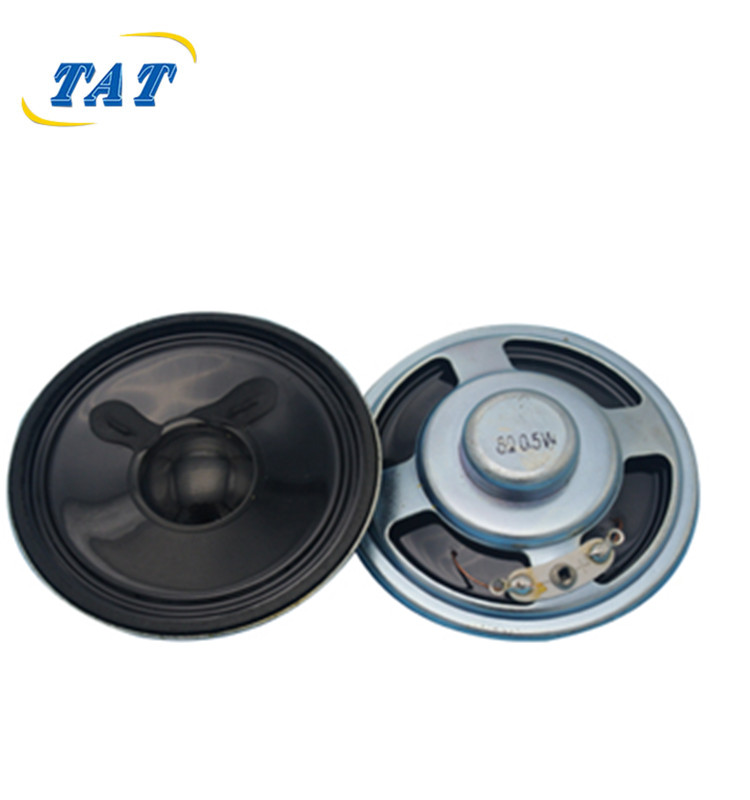
Every engineering decision in a portable speaker is a negotiation with the battery.
If your design requires loud outdoor projection, you might calculate the current draw using Ohm's Law (P = V²/R and I = V/R). Drawing more current to achieve higher SPL drains the battery faster. To maintain a reasonable playtime (e.g., 10+ hours), you must either increase the physical size of the battery (adding weight, cost, and charging time) or compromise on the maximum output.
Illustrative method only; not a TAT product specification.
Designing with an IP-rated speaker does not automatically make your product IP-rated. The rating belongs to the enclosure and the assembly, not to the driver alone — which is why a "waterproof" speaker can still be the reason a device fails in the field.
The speaker component is essentially a hole in your device's housing. While a Mylar diaphragm inherently repels water better than untreated paper, moisture can still ingress around the edges of the driver basket, through the mounting gasket, or via the acoustic vents. Achieving an IP67 rating for a final product requires a holistic approach: sealing the enclosure joints, applying acoustic meshes (which allow air to pass but block water droplets), and ensuring the driver is clamped with precise torque against a waterproof gasket.
For the driver component itself, Mylar (PET film) is the industry standard for micro and compact speakers facing humidity. It does not absorb moisture, remains acoustically stable across varying humidity levels, and can be manufactured to exceptionally thin tolerances.
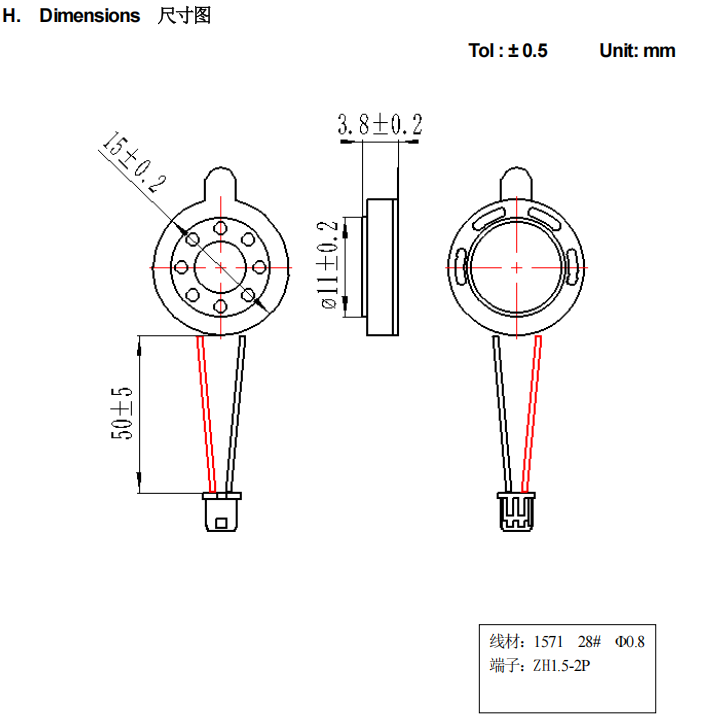
Compact outdoor gear also demands ultra-thin profiles. The dimensional drawing for a standard 15 mm micro driver shows a complete acoustic package compressed into a thickness of just 3.8±0.2 mm, with thin Mylar film providing the excursion without contacting the front grille.
As a lithium-ion cell discharges its output voltage falls. Since the amplifier is bounded by that supply, the maximum unclipped power it can deliver also falls. This is why many outdoor speakers cut maximum volume or flatten bass — the most power-hungry part of the signal — once the battery drops below about 20%.
The driver is the primary load, but inefficient Class-AB output stages (rare in modern portables), poorly optimised bluetooth receiver chips and excessive LED lighting all eat into the power budget. A high-efficiency Class-D amplifier paired with a correctly matched driver impedance stretches every milliamp-hour.
Outdoor speakers collect dirt, sand and salt spray, so the cleaning protocol matters. Never use high-pressure air or a direct water jet on the grille, even if the device claims an IP rating: pressure can force water past the acoustic mesh or permanently deform the thin Mylar diaphragm behind it. A damp cloth or soft brush across the outer grille is the only safe method.
Before a summer trip, users should inspect the rubber seals over the charging ports and the integrity of the grille. Once those external seals degrade, the internal electronics are exposed and the driver's own moisture resistance becomes irrelevant.
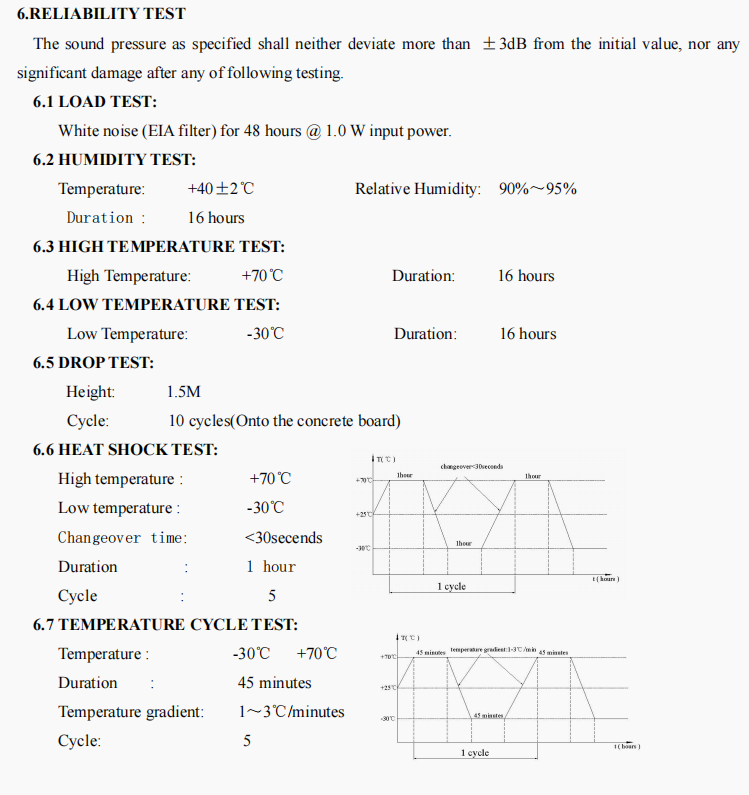
For the component to survive seasonal extremes, OEMs must rely on test data rather than marketing claims. Published reliability data for the TAT-S57F2-8-1 driver covers 16 hours at 90–95% relative humidity and +40±2°C, thermal cycling between -30°C and +70°C, and repeated 1.5 m drops onto concrete — all held to an SPL deviation of no more than ±3 dB.
Specification sheets in this category vary between revisions and grades. The three values you must have in writing before tooling — impedance, rated input power, and maximum power — are frequently the three that marketing copy simplifies. Ask for the controlled specification sheet for the exact grade you are buying, not the catalogue line.
When evaluating a supplier for outdoor bluetooth speaker components, request their environmental test protocols alongside the acoustic data. TAT Electronics provides comprehensive Mylar speaker solutions with proven reliability data. Whether you need a compact component or an 8Ω 1W micro Mylar speaker for your multi-media speaker assemblies, our engineering team can support your product integration.
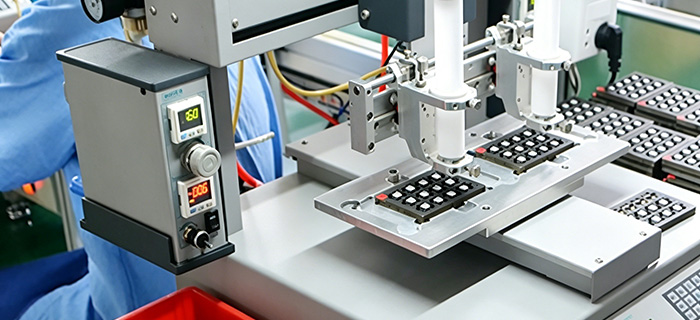
Choosing a driver for outdoor leisure products comes down to the order in which you solve three variables. Set the SPL target for the furthest listener first, because free-field attenuation removes roughly 6 dB each time the distance doubles and no practical battery budget recovers that gap through wattage alone. Match nominal impedance to the amplifier supply second, since a 4Ω load and an 8Ω load draw very different currents from the same cell. Treat moisture as an enclosure problem third — a moisture-resistant diaphragm such as Mylar helps, but the gasketing, clamping torque and acoustic mesh around the driver decide what the finished product actually survives.
Your next steps are largely documentary. Request the controlled specification sheet for the exact grade you are buying, and ask for the environmental protocols — humidity soak, thermal cycling and drop testing — alongside the acoustic data. Confirm in writing that impedance, rated input power and maximum power are stated for that grade rather than inherited from a catalogue line.
Before you commit to tooling, validate the driver inside a representative enclosure rather than on an open bench, and re-check the power budget at the lowest battery state your product will allow.
A: For most 3.7V to 7.4V battery-powered portable amplifiers, 4Ω or 8Ω drivers are standard. A 4Ω load draws more current to maximize volume, while an 8Ω load is more efficient and extends battery life. Your choice depends entirely on your amplifier IC specs and battery capacity.
A: You must seal the enclosure. Use a driver with a moisture-resistant synthetic diaphragm (like Mylar) and protect the acoustic opening with hydrophobic meshes and proper gasketing. The driver alone cannot stop water from entering the device housing.
A: Wipe the exterior grille with a damp cloth or soft brush. Do not use compressed air, vacuums, or direct water pressure, as these can rupture acoustic meshes or push water past the seals and damage the driver diaphragm.
A: Yes. Our engineering team provides detailed specification sheets and prototyping samples, including models like the ultra-thin Mylar speaker S3020, to ensure the components meet your exact electrical and dimensional requirements before mass production.
A: Users typically play speakers at maximum volume outdoors because there are no walls to reinforce the sound. Driving the amplifier at maximum output to overcome open-air dissipation draws significantly more current, drastically reducing battery life compared to indoor listening at moderate volumes.


