
English 
Dedicated to global electroacoustic technology.


| Quantity: | |
|---|---|
The BM9055 Electromagnetic Buzzer is a precision-engineered electro-acoustic component designed to generate sound through the interaction of a magnetic field and a vibrating diaphragm. When a direct current passes through the internal coil, it creates a magnetic force that drives the diaphragm to vibrate, producing clear and audible tones. Constructed with temperature-resistant industrial-grade plastics, such as PBT, the outer housing ensures exceptional physical stability, preventing any deformation during rigorous wave or reflow soldering processes.
These buzzers are widely recognized for their stable sound output, simple driving circuits, and reliable performance at low voltages. With moderate power consumption and a crisp tone quality, they are widely used in alarms, household appliances, industrial equipment, and electronic devices for notifications, warnings, and status indications. Furthermore, the product fully complies with international environmental and safety standards, including RoHS, facilitating smooth and compliant entry into global electronics markets.
Electromagnetic buzzers provide highly stable sound output due to their precision coil-driven diaphragm structure. The tone is fixed by the 2731 Hz resonance of the coil-driven diaphragm, ensuring consistent and clear tones across different applications. Before leaving the facility, each unit undergoes 100% automated acoustic parameter inspections and rigorous high-low temperature aging tests. This guarantees that every buzzer delivers a sound pressure level of at least 80 dB at 10 cm. This acoustic stability makes them highly suitable for critical systems requiring precise, repeatable, and unmistakable sound signaling.
These buzzers are passive transducers: they need an external square-wave drive of 2 to 5 Vo-p and contain no oscillator circuit of their own, so the drive signal sets the tone. Operating voltages range from 2 to 5 Vo-p, making them compatible with a wide array of electronic systems. Their straightforward integration reduces design complexity and lowers overall system cost. Additionally, the pin dimensions and layouts are engineered to perfectly match automated SMT pick-and-place machines. They fully support standard wave soldering or reflow soldering techniques, effectively improving production line yield rates for electronics manufacturers.
The BM9055 strikes an optimal balance between power consumption and sound output, drawing up to 70 mA at 3 Vo-p while delivering strong, penetrating audio tones. This efficiency makes them suitable for both portable gadgets and fixed installations where clear alerts are required without draining excessive energy. Engineered for environmental reliability, the buzzer maintains its stable audio output across a temperature range from -20°C to +70°C, performing consistently even in high-humidity industrial environments.
Electromagnetic buzzers are widely applied in alarms, home appliances, automotive electronics, and industrial systems. They offer extensive flexibility in terms of resonant frequency (2731 Hz on this model), sound pressure level, size, and mounting type (SMD or through-hole) to meet specific design requirements. To support diverse engineering needs, flexible OEM and ODM services are available. Development teams can request customized pin lengths, specific wire specifications, or special frequency tuning tailored to unique PCB layouts and acoustic requirements.
Parameter | Specification |
|---|---|
Operating Voltage | 2 ~ 5 Vo-p |
Current Consumption | Max. 70 mA (2.731 kHz, 50% duty, 3 Vo-p) |
Sound Pressure Level (at 10cm) | Min. 80 dB |
Frequency Range | 2731 Hz |
Coil Resistance | 16 ± 4 Ω |
Operating Temperature | -20°C to +70°C |
Housing Material | Black PBT |
Compliance | RoHS |
Datasheet: TAT BM9055-0327-16 Datasheet (PDF, 5 pages, 505 KB)
The document contains the full specification, the dimensional drawing, the reliability test conditions, the measuring condition with the recommended driving circuit, the frequency response curve, the wave soldering profile and the carrier tape drawing.
This is a passive electromagnetic transducer with no oscillator of its own. Every acoustic figure below assumes a 3 Vo-p, 50 % duty square wave applied at the resonant frequency, with sound pressure read at 10 cm on the axis.
That single fact drives most field complaints: feed it DC and it stays silent, feed it at the wrong frequency and the output drops by 10 dB or more. The tone and the loudness are both set by the signal you supply, so select the drive frequency first and the supply rail second.
Coil resistance is the specification to check on incoming inspection: it is measurable with a plain multimeter, and a reading outside 12 - 20 Ω points to a damaged winding before the part ever reaches your acoustic test.
Parameter | Test Condition | Min | Typ | Max | Unit |
|---|---|---|---|---|---|
Rated Voltage | 3 Vo-p, 50 % duty square wave | — | 3 | — | Vo-p |
Operating Voltage | — | 2 | — | 5 | Vo-p |
Rated Current | 2.731 kHz, 50 % duty, 3 Vo-p | — | — | 70 | mA |
Sound Output | 2.731 kHz, 50 % duty, 3 Vo-p, 10 cm | 80 | — | — | dB |
Coil Resistance | — | 12 | 16 | 20 | Ω |
Resonant Frequency | — | — | 2731 | — | Hz |
Net Weight | — | — | 1.5 | — | g |
After any of the tests below the part shall meet specification without any degradation in appearance and performance other than SPL, and SPL shall not deviate more than -10 dB from the initial value.
Test Item | Test Condition | Acceptance Criteria |
|---|---|---|
Ordinary Temperature Life | 96 h at 25 ±10 °C, rated voltage, resonant frequency, 1/2 duty square wave | SPL change ≤ 10 dB |
High Temperature Storage | +85 °C for 96 h, then 2 h at normal condition | No visible damage |
Low Temperature Storage | -40 °C for 96 h, then 2 h at normal condition | No visible damage |
Humidity | +40 ±3 °C, 90 - 95 % R.H. for 48 h, then 6 h at room temperature | No visible damage |
Temperature Shock | 70 °C / 1 h → 25 °C / 3 h → -30 °C / 1 h → 25 °C / 3 h, 10 cycles total | No visible damage |
Drop Test | Standard packaging dropped from 1.2 m onto 5 cm hard board, 3 sides, 6 faces | No visible damage |
Vibration | 1000 cycles/min, amplitude 1.5 mm, 1 h on each of 3 axes | No visible damage |
This is a through-hole part, so wave soldering is the production process. The profile below is the recommended wave window; hand soldering is for rework only and must stay inside the same limits.
Process Step | Recommended Parameter |
|---|---|
Pre-heat | 100 °C for 20 sec |
Solder bath | 260 °C |
Contact time in the wave | 60 - 100 sec total |
Absolute maximum | 265 °C for 2 sec max. |
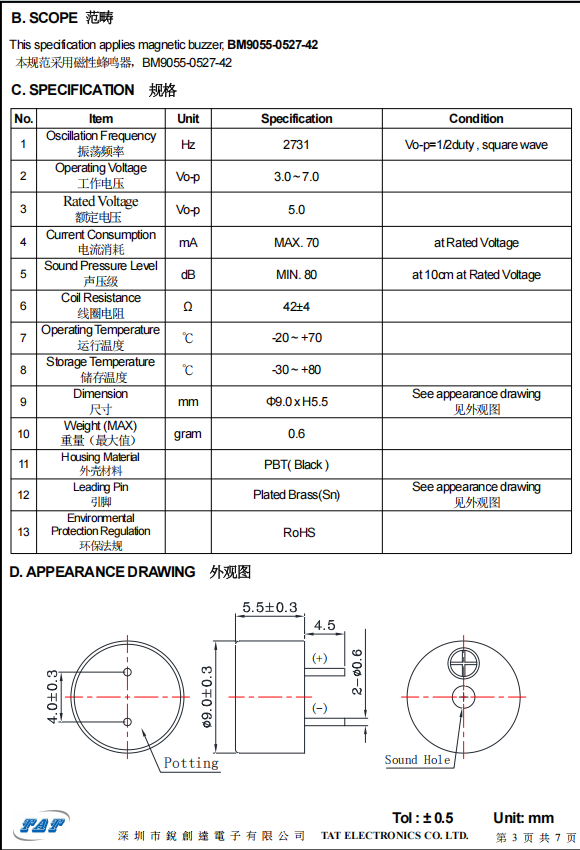
Pins — length L1 = 4.5 ±0.5 mm, diameter Φ 0.6 ±0.1 mm; allow the matching hole and annular ring in your footprint.
Body — Φ9 × H5.5 mm, black PBT housing, tolerance ±0.5 mm except where specified, net weight approx. 1.5 g.
Foreign material is the most common field failure cause. The part is not sealed against ingress, so keep magnetic powder, washing solvent, flux residue and corrosive gas out of the housing during your production process — contamination inside the cavity reduces sound output and can silence the part.
Integrated into fire alarms, intrusion detectors, and safety warning systems, these components provide clear and continuous sound signals to alert users of emergencies or abnormal conditions. Their stable frequency and strong sound output ensure effective notification across indoor spaces and semi-industrial facilities.
In daily household appliances like microwave ovens, washing machines, air conditioners, and induction cookers, electromagnetic buzzers serve as operation reminders and status alerts. They emit a distinct, pleasant chime when a cycle is completed or alert the user with rapid beeps when an error occurs, enhancing usability and daily interaction.
Commonly embedded into industrial control panels, automation systems, and heavy machinery, they act as audible indicators for system status, fault alarms, and operational warnings. Their resilient construction and stable performance make them highly suitable for factory environments that demand continuous, uninterrupted operation.
Utilized in devices such as telephones, digital timers, electronic toys, and small gadgets, they provide immediate sound cues for button presses, alerts, and notifications. Their straightforward driving method and consistent sound output present a practical, cost-effective acoustic solution for consumer product designers.
In access control devices, door entry systems, and security panels, these buzzers generate confirmation tones and warning sounds. They improve system interaction by providing immediate audio feedback—such as a short beep for a successful card swipe or a continuous tone for unauthorized access—ensuring better communication and safety awareness.
When selecting an electromagnetic buzzer, it is essential to consider the rated voltage and current to ensure compatibility with your specific circuit design. Evaluate the sound pressure level (at least 80 dB at 10 cm on this model) based on the intended usage environment, ensuring the tone will be clearly audible over ambient noise. Check the frequency stability (2731 Hz on this model) for consistent tone output across the lifespan of your device. Ensure the size and mounting type (SMD or through-hole) fit your PCB layout perfectly.
For production and supply chain planning, these components are supplied in standard Tape & Reel or Tray anti-static packaging. This ensures smooth, uninterrupted feeding into automated production lines and provides reliable, scaled delivery schedules. Always review operating temperature limits, physical durability, and compliance standards like RoHS to ensure reliable performance and a better end-user experience.


