
English 
Dedicated to global electroacoustic technology.
Views: 0 Author: Site Editor Publish Time: 2026-11-10 Origin: Site


Under the EU Medical Device Regulation 2017/745, the legal manufacturer owns the technical documentation, the risk management file and post-market surveillance. What gets misread is where the raw material for those files comes from when the product carries an audible alarm.
IEC 60601-1-8 is the collateral standard for alarm systems in medical electrical equipment. It establishes alarm priorities, the behaviour and acoustic character attached to each priority, and the principle that the alarm system is a controlled, documented property of the device. Read the current edition in full. Summaries circulating online contradict each other, and a design argument built on a summary is how projects end up re-testing: IEC 60601-1-8 on the IEC webstore.
None of that can be demonstrated from the device maker's chair. The alarm's audibility comes from a transducer whose output depends on ceramic composition, cavity geometry, adhesive bond line, drive waveform and mounting stiffness. You can specify the drive circuit and design the enclosure, but you cannot inspect parts you did not make. When a reviewer asks why unit 5,000 sounds like unit 5, the answer is a document, not a decision.
So the reframe, in week one: buzzer qualification is a paperwork discipline before it is an acoustics problem, and a medical buzzer supplier's job is to hand over evidence you can file, not a specification you have to trust.
Most supplier packs run to forty pages and answer four questions. These six are the ones that get opened during a design review, an incoming inspection dispute or a notified body visit.
It proves the number was measured on an identified sample under stated conditions and can be reproduced by someone else. Without it, your own first measurement becomes your only measurement, after tooling is paid for.
Minimum and maximum across a stated sample size prove the spread you are buying, which sets your audibility margin. A typical-only figure describes the middle of a population you will never entirely receive; teams that qualify on the median and ship the tail find out in the complaint log.
They prove the part still behaves at the corners where your device operates: a cold ambulance bay, a warm enclosure beside a power supply, a battery at the end of discharge. Room-temperature data describes the bench, and the bench is rarely the quietest corner.
They prove that next month's shipment is the part you qualified. Ask for lot-linked test data rather than a certificate of conformity. A certificate confirms someone looked; data confirms what they saw.
It proves you will hear about a material change before it enters your line. This document protects the other five, and it is the one most often missing from the pack.
It proves the alarm still behaves at end of service life. Adhesive creep, ceramic micro-cracking and thermal cycling move both resonance and output level; a receiving-inspection pass says nothing about year five.
A sound pressure number with no conditions attached is not data, it is marketing. Six conditions decide whether two figures can be compared at all: measurement distance, drive waveform (sine or square), duty cycle, drive voltage stated as peak-to-peak rather than RMS, drive frequency relative to the part's resonance, and free-field versus in-enclosure measurement.
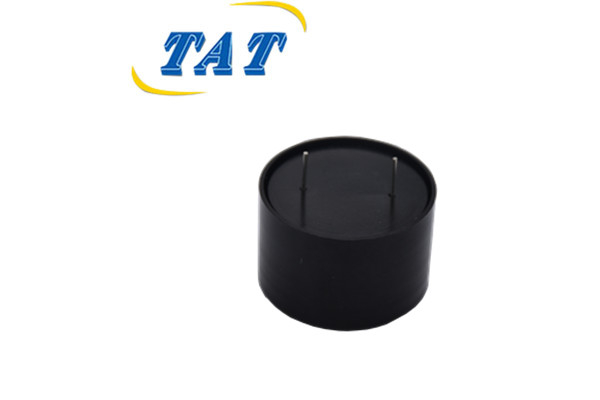
A well-formed claim looks like the one on the BPC4020-0930 40 mm piezo buzzer: ≥ 95 dB at 10 cm, up to ~100 dB, measured at 3 kHz with 50% duty and a 9 Vp-p drive. Every variable that changes the result is on the page. Working voltage is given as 1 – 25 Vp-p with 9 Vp-p typical; current is ≤ 5 mA under that same 3 kHz, 50% duty, 9 Vp-p square wave; frequency is 3000 ± 500 Hz; operating temperature is -20 °C ~ +70 °C; the tone is continuous; the body is in the 40 mm class. Each line is something you or a lab can test against.
Two follow-up questions are worth asking even of a good claim. Is the 95 dB figure the minimum of the population or the minimum of the sample? And what happens at the edges of the band? A tolerance of ± 500 Hz is honest about spread, yet a part resonating near the low edge will not deliver the same level when driven at 3 kHz; a swept response curve answers that in a page.
The distance needs watching too. A 10 cm free-field figure is a component-level convention: useful for comparing parts, useless for predicting what a nurse hears through a sealed housing. The standard describes the signal your device produces; the catalogue figure describes a transducer on a bench.
Nobody re-runs a full qualification on every lot, and asking for it marks you as a buyer who has not shipped a product. Ask instead for the control plan behind the certificate.
Every parameter that actually moves — resonant frequency, sound pressure at the reference condition, current draw, and for piezo parts the ceramic lot and the bond line — should have a defined test method, a sampling rule and a capability figure. Ask which parameters are tested on 100% of units and which are sampled. Ask for twelve months of lot data as a trend, not a stack of pass stamps: a trend shows drift, stamps only show that someone drew a limit line.
Two additions are cheap and rarely refused: a retained golden sample per part number, sealed and dated, so a future dispute has a physical reference; and an agreed re-test interval that turns "the process is stable" into a claim with a date on it.
If a supplier lists a broad piezo buzzer range, ask one extra question: is the control plan written per part number or per family? Family-level plans are efficient, and they are exactly where an individual part number drifts quietly while the family average holds.
Price, lead time, MOQ and payment terms get argued over for weeks. The paragraph defining what counts as a change gets signed as boilerplate, and it decides whether your design freeze survives the next two years.
Three things belong in it. A definition of change that covers sub-tier substitution — ceramic supplier, housing resin, adhesive, lead wire, plating — and not only the finished part number. A notice obligation that fires before the first changed unit ships, long enough to run a bridging test and, if needed, update your technical documentation. And a stated route to reject a change and require the previous configuration, with a last-time-buy option attached.
The field failure looks like this: the part number does not change, so the supplier's system records no change, so nobody tells you. Eight months later an incoming inspection trend shifts and no paper trail explains it. That is the most common route by which a qualified alarm buzzer becomes an unqualified one.
Six that recur, all cheaper to fix in a design review than in a corrective action.
Conformal coating or potting adds mass to the diaphragm and pulls resonance down; a part specified at 3 kHz can land several hundred hertz lower after the coating process.
The sound port gets sized for cosmetics instead of acoustics: hole too small, channel too deep, or a gasket partly covering the opening.
The drive circuit cannot deliver the stated swing. A microcontroller pin on a 3.3 V rail gives a fraction of a 9 Vp-p drive, and sound pressure does not fall linearly with voltage.
Reflow or wave solder heat warps the housing or stresses the diaphragm; units pass receiving inspection and fail after assembly.
Mounting preload — an over-torqued screw, a tight snap fit, a potted edge — damps the diaphragm and costs output.
Aging: adhesive creep and ceramic micro-cracking move both resonance and level across service life.
A supplier who has handled field returns answers these from memory and names the test that catches each one. One who has not answers in generalities, and that difference is your signal.
Score every line 0, 1 or 2. Two points when the evidence exists and is specific to your part number, one when it exists but is generic or family-level, zero when it is a promise.
What you ask for | A two-point answer | A zero-point answer |
|---|---|---|
Sound pressure claim | distance, waveform, duty, drive voltage and frequency all stated | one number, no conditions |
Distribution | minimum and maximum from a stated sample size | typical value only |
Temperature behaviour | sweep across your envelope, e.g. -20 °C ~ +70 °C | room temperature only |
Lot control | plottable trend data for twelve months | certificate of conformity |
Change control | sub-tier changes covered, notice before shipment | "we will inform you if needed" |
Life data | measured drift after environmental exposure | a datasheet endurance claim |
Run this against two shortlisted medical buzzer suppliers before the enclosure is frozen. Any zero in the change-control row is a project risk regardless of price: it converts a qualified part into an unknown one without anyone making a wrong decision.
Nothing here asks a supplier to be certified, audited or exceptional. It asks for specificity: conditions attached to claims, distributions instead of typicals, trends instead of stamps, and a signature on a clause that says you will be told before something changes. Those four habits turn an alarm buzzer from a line on a BOM into evidence that survives a design review.
Start early. Asking these questions in a sourcing meeting costs ten awkward minutes. Asking them after tooling, coating validation and EMC testing costs a requalification cycle with a launch date on it.
No. Component data describes a transducer on a bench; the standard describes the signal your finished device produces in its enclosure. The supplier's report tells you what the part can do and whether it is repeatable. Demonstrating the alarm behaviour remains your verification work.
Only as a screening number. Ask for minimum and maximum across a stated sample size, because your audibility margin is set by the low end of the distribution, not the middle. A good supplier usually has that data and simply has not been asked.
Treat it as a priced risk rather than a dead end. Add acoustic screening at incoming inspection, widen your design margin, and put the missing evidence on the risk register. If the same supplier also refuses a change notification clause, look elsewhere.
Yes, at minimum a bridging test. A different ceramic lot, resin or adhesive can move resonance and output without changing the part number or the drawing. The scope of that test belongs to your risk assessment, but the trigger should be defined in the quality agreement before the change happens.


